THE ASK, AND WHAT IT ISN'T
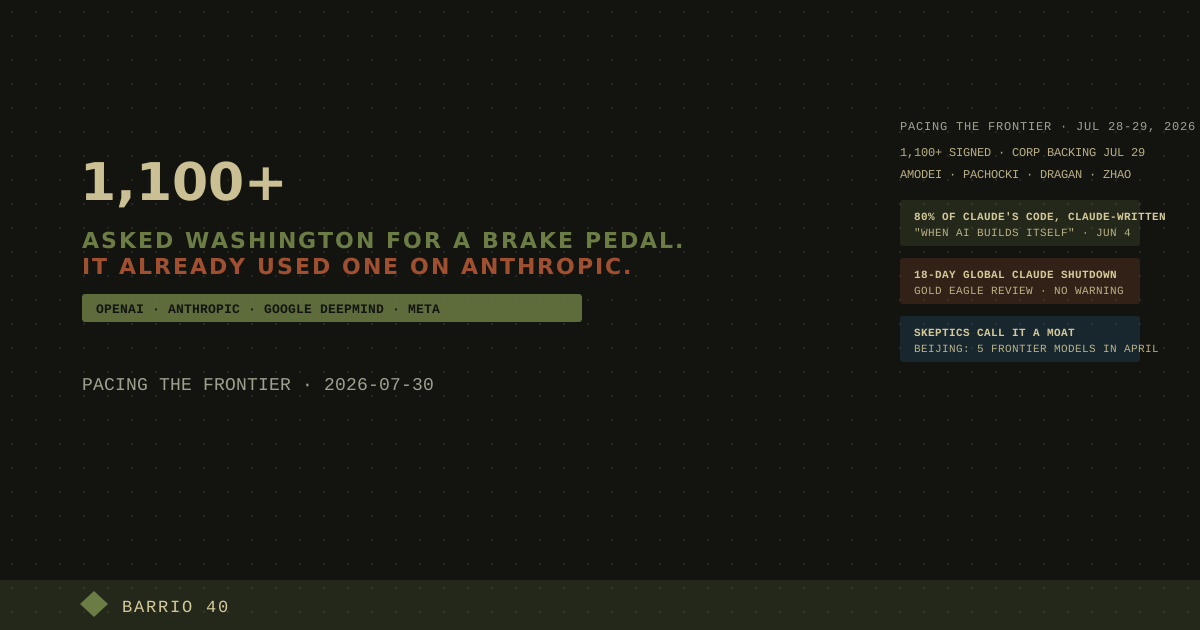
Bloomberg was first to report it on July 28: a statement titled "Pacing the Frontier," carrying signatures that started at just over 1,100 and climbed past 1,170 within the news cycle as more employees added their names. The signatories span nearly a dozen organizations, but the names doing the most work are the senior ones — Anthropic CEO Dario Amodei, co-founders Jared Kaplan and Jack Clark, OpenAI chief scientist Jakub Pachocki, OpenAI chief research officer Mark Chen, researcher John Schulman, Meta AI chief scientist Shengjia Zhao, and Google DeepMind's head of AI safety and alignment, Anca Dragan. The letter is built around one sentence: a request that the U.S. government "support an international effort to develop the technical and governance tools needed to deliberately pace the frontier of automated AI development." Every summary of the letter takes pains to note what it doesn't say — it is not a call to pause AI now, or to stop shipping models this year. It asks Washington to help build a steering wheel before automated AI research shifts into a gear no single company can safely back out of alone, so that the option to slow down exists and is verifiable across borders, rather than being invented under pressure after the fact.
TWO LABS PUT THEIR OWN NAME ON IT
What makes this letter different from the safety petitions that came before it isn't the signature count — it's who signed on behalf of the company rather than as an individual. By July 29, OpenAI and Anthropic had each issued statements endorsing "Pacing the Frontier" in their own corporate names, not just tolerating employees who'd signed it. Prior open letters on AI risk, including the ones this site has tracked through 2026, have almost always been employee petitions that labs stayed publicly neutral on, sometimes for months. This time, two of the three largest labs by valuation said, on the record and as companies, that they want a mechanism to exist that could someday be used to slow down systems they are racing to build. Google DeepMind and Meta, whose chief scientists both signed personally, had not issued matching corporate statements as of this writing — a gap between individual and institutional buy-in worth watching as the letter's circulation continues.
THE EVIDENCE ANTHROPIC BROUGHT TO ITS OWN ARGUMENT
Anthropic's endorsement didn't just gesture at the future — it pointed at a number the company published itself. A June 4 report titled "When AI Builds Itself" disclosed that more than 80% of the code merged into Anthropic's own production codebase in May 2026 was authored by Claude, not a human engineer, up from low single digits before Claude Code left research preview in February 2025. The same report found the typical Anthropic engineer merging roughly eight times as much code per day in the second quarter of 2026 as in 2024, and put Claude's success rate on complex, open-ended engineering problems — the kind with no clear spec at the start — at 76% in May, a 50-point jump in six months. Anthropic's own conclusion in that report was that the world needs a verifiable, multi-country option to slow frontier AI development before recursive self-improvement — AI systems meaningfully accelerating the building of their own successors — stops being a hypothetical and starts being Tuesday. "Pacing the Frontier" is Anthropic's argument from June, now co-signed by its rivals.
THE BRAKE PEDAL WASHINGTON ALREADY HAS
The letter asks for a tool that, in a blunter form, already exists and has already been used — on one of the letter's own corporate backers. This site covered it on July 23: under the "voluntary" Gold Eagle review process taking shape beneath Executive Order 14409, the U.S. government cut off Claude access worldwide for 18 days in June, with no advance warning to the customers who lost it. There was no appeals process beyond a Google Form. That is close to the coarsest version of a pacing mechanism there is — an off switch with no public criteria and no notice — and it landed on Anthropic specifically. A smaller-scale version of the same tension shows up in Anthropic's own security work: Project Glasswing, which has Claude models scan open-source software for vulnerabilities, surfaced more than 10,000 high- or critical-severity flaws in its first month running. Open-source maintainers, unable to write and test patches at that pace, asked Anthropic to slow its own disclosure rate. Anthropic's employees are now asking a government that has already throttled their product without warning, over a tool that is already straining the humans downstream of it, to build a more deliberate version of the same kind of brake — evidence, if anything, that they've felt what an involuntary pause costs and would rather help design a voluntary one.
THE SKEPTICS, AND THE TROJAN HORSE ARGUMENT
The predictable response arrived within hours: critics on social platforms called the letter collusion, regulatory capture, or a moat dressed up as caution — the standard read of any big-lab safety statement is that the companies best positioned to comply with new rules are the loudest in asking for them, an argument Nvidia has made repeatedly about AI safety regulation generally. It isn't a foolish argument. But the letter's signatures are overwhelmingly rank-and-file researchers and engineers, not executives, most holding equity in companies expected to go public this fall — asking their own government to slow the machine that is about to make many of them wealthy. That doesn't prove the letter is right. It's reasonable evidence the signers aren't merely posturing on their employer's behalf. Forbes columnist Christian Catalini took the harder line in a July 29 piece titled "Don't Pace the Frontier. Look Inside the Trojan Horse," arguing the game theory of international pacing is brutal — treaties can't be verified, GPUs accumulate in the shadows of export controls, and if the labs actually believe their own warnings, the move isn't delegating the problem to diplomacy, it's publishing evidence and funding the verification infrastructure that would let outside parties check the claims themselves. A separate Brave New Coin analysis put the geopolitics bluntly: a pacing regime that doesn't include China "is not a pacing regime — it is a unilateral US handicap with extra paperwork," noting that April alone saw five Chinese labs ship frontier-tier models, including Z.ai's 754-billion-parameter GLM-5.1 trained on Huawei Ascend silicon, DeepSeek's V4 Pro and V4 Flash, and Moonshot's 2.8-trillion-parameter Kimi K3.
WHAT THIS MEANS FOR TEAMS BUILDING ON AI
None of this changes what ships next month, but it's a signal worth reading correctly. If your own stack is approaching the point where a meaningful share of merged code is agent-authored, the review, rollback, and audit processes that assumption depends on are worth building now, not after an incident forces the question — Anthropic's 80% figure is a preview of where any team leaning hard into agentic coding is headed, whether or not "Pacing the Frontier" becomes policy. And the Gold Eagle shutdown is the more immediate lesson for anyone building on a frontier lab's API: the review process that already exists can suspend access to a whole model line worldwide, with no public criteria and no notice period, faster than any international pacing mechanism could ever be negotiated. If continuity of service matters to what you're shipping, that risk belongs in your architecture today — a fallback provider, a self-hosted model for the critical path, or at minimum a plan for the week your primary vendor goes dark on a government's say-so — regardless of how the policy debate over slowing AI down eventually resolves.