THE OFFER: $42.6 BILLION, AND A TEMPLATE FOR THE REST OF THE INDUSTRY
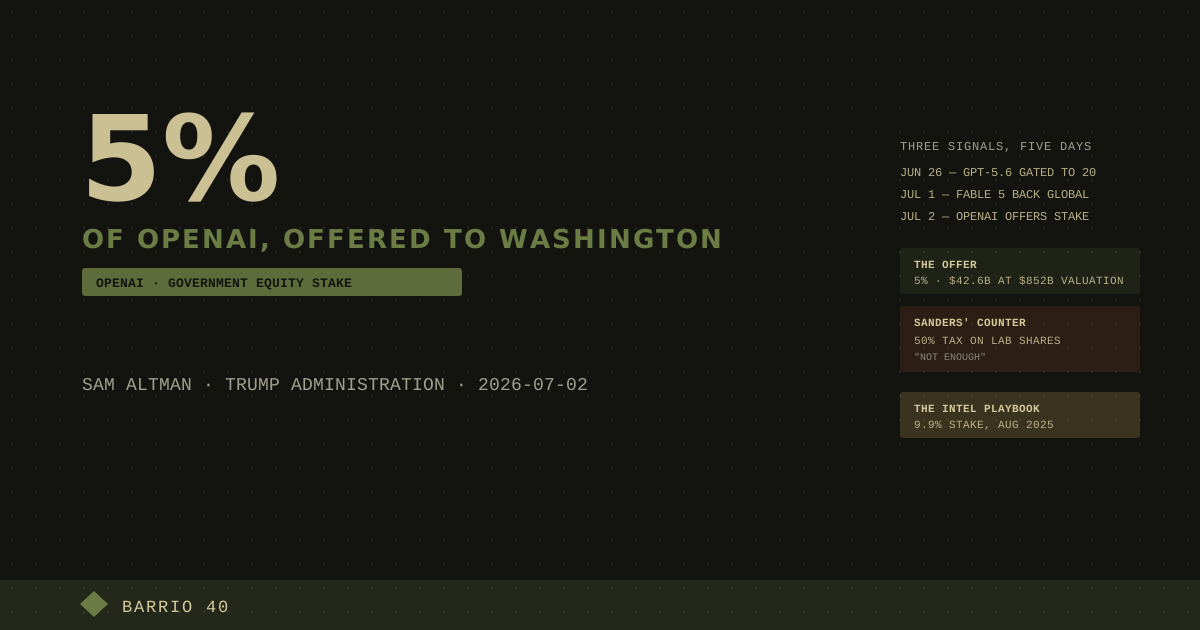
The mechanics of the proposal, as reported by the Financial Times and confirmed in broad strokes by multiple outlets since, are more specific than the framing of "OpenAI gives the government a stake" suggests. Five percent of OpenAI, at the roughly $852 billion valuation implied by its March funding round, comes to about $42.6 billion — a figure large enough that it functions as a genuine transfer of value, not a symbolic gesture. Altman's framing is that this lets the public share directly in AI's financial upside, structured through what he has described as a government-seeded Public Wealth Fund rather than a direct line item on the Treasury's balance sheet. Critically, OpenAI is not proposing to do this alone: the company has suggested that other US AI labs contribute similar stakes to the same fund, though it remains unclear whether Anthropic, Google DeepMind, or any other competitor has any appetite to follow. Trump has already signaled he likes the shape of the idea in principle — he said in June that government ownership stakes in AI giants would be "a beautiful thing" that would make the American public "partners in this revolution" — which gives Altman's proposal a receptive audience even before the details of governance rights, board representation, or voting power attached to the stake have been made public.
THE INTEL PLAYBOOK
The proposal doesn't arrive in a vacuum; it arrives after the administration already normalized the mechanism. In August 2025, the US government acquired a 9.9% stake in Intel, worth roughly $8.9 billion at the time, largely by converting existing CHIPS Act grants into equity at $20.47 a share. Intel's stock has since roughly quadrupled, and that outcome is now doing a lot of political work: it lets Trump and Altman both point to a concrete, reportable example of "look how well this worked out for taxpayers" rather than arguing the concept in the abstract. What that comparison elides is that Intel took government equity from a position of weakness — a company that needed the capital and the political cover to justify further federal support — while OpenAI is proposing to hand over a stake from a position of extraordinary strength, as one of the most highly valued private companies in the world, in exchange for something considerably harder to price: a reduction in the kind of unpredictable regulatory friction that has already delayed one of its own model launches this year. The administration, for its part, already holds ownership positions — through equity, warrants, or so-called golden shares — in roughly twenty private companies spanning critical minerals, semiconductors, and quantum computing, which means a stake in OpenAI would extend an established pattern rather than establish a new one.
THE THIRD SIGNAL IN FIVE DAYS
Read on its own, OpenAI's equity offer is a corporate finance story. Read against what this site has covered over the past week, it's the third and most direct data point in a fast-forming pattern. On June 26, OpenAI shipped GPT-5.6 — Sol, Terra, and Luna — only to roughly 20 pre-screened partner organizations after the administration's Office of the National Cyber Director and Office of Science and Technology Policy asked the company to limit the rollout over concerns about the model's cyber and biology capabilities, with general availability pushed to "a couple of weeks later," in Altman's own words. On July 1, Claude Fable 5 came back online worldwide after a nineteen-day export-control shutdown triggered by a single verbal briefing from Amazon's CEO to the Treasury Secretary — a shutdown this site tracked start to finish, and one that ended only after Anthropic retrained its safety classifier and Commerce Secretary Lutnick personally signed off. Now, on July 2, OpenAI is proposing to hand the government a $42.6 billion ownership position in the company that builds the models it sells. Three different labs, three different mechanisms — a staggered release, an emergency shutdown, an equity offer — but the same underlying shape: in each case, a frontier AI company's product roadmap or cap table moved because of a decision made inside the federal government, not because of a decision made inside the company alone. Whether that counts as regulatory capture running in the opposite direction — labs buying goodwill instead of governments imposing rules — or simply an early and unusually candid form of industrial policy for the AI sector depends on where you're standing, but the trend line itself is no longer ambiguous after this week.
SANDERS: "NOT ENOUGH," AND TWO DIFFERENT PLAYBOOKS FOR HANDLING WASHINGTON
The pushback to Altman's offer hasn't come from the right, where the administration has broadly welcomed the idea, but from the left flank Altman apparently hoped to preempt. Sanders has publicly dismissed the 5% offer as insufficient, calling instead for a one-off 50% tax on the shares of OpenAI, Anthropic, and xAI — a blunt, legislated transfer rather than a negotiated, voluntary stake that leaves the labs choosing their own terms and timing. The distinction matters beyond the headline percentage: a negotiated equity stake is a deal a CEO can shape, attach conditions to, and use as leverage in exactly the kind of access disputes that have already played out twice this month, while a mandated tax is not something any lab gets to negotiate its way out of. That contrast is sharper still when set against how Anthropic has handled its own confrontations with the same administration this year — the company fought the Pentagon in court over language that would have permitted its models to be used for mass domestic surveillance and fully autonomous lethal weapons systems, an adversarial posture that cost it a temporary directive ordering federal agencies to stop using its products entirely before a court of appeals eventually let that directive stand. OpenAI's stake offer is the opposite instinct: rather than litigate the boundary of acceptable government use case by case, hand over a piece of the company and let goodwill do some of that work in advance. Whether that trade proves cheaper than Anthropic's legal bills, or simply defers the same fight to a later and less advantageous moment, is the open question the rest of the industry is now watching two live experiments answer in parallel.
WHAT THIS SIGNALS FOR TEAMS BUILDING ON THESE MODELS
None of this is finalized. A reported proposal discussed in private meetings is not a signed agreement, the governance terms attached to any eventual stake haven't been disclosed, and no other lab has confirmed it will participate in the Public Wealth Fund structure Altman is pitching. But the practical signal for any team whose product roadmap depends on a frontier model doesn't require the deal to close to be worth acting on. This is the same lesson this site drew from the Fable 5 shutdown twenty-four hours ago, arriving from a different direction: the relationship between the US government and the handful of companies that build frontier AI is no longer a background regulatory concern that shows up once a year in a compliance review. It is now a live, week-to-week variable that shapes which models ship on schedule, which stay gated to pre-approved partners, and — as of this week — who sits, even nominally, at the capital table of the vendor you depend on. Teams building production systems on OpenAI, Anthropic, or any other frontier lab should treat that as one more reason the redundancy planning this site has repeated through June and into July isn't hypothetical: know which workloads can fail over to an alternative provider or an open-weight model, and at what quality cost, because the entity making decisions about your primary vendor's availability increasingly isn't only that vendor anymore.