THE LARGEST OPEN-WEIGHT MODEL EVER, RIGHT ON SCHEDULE
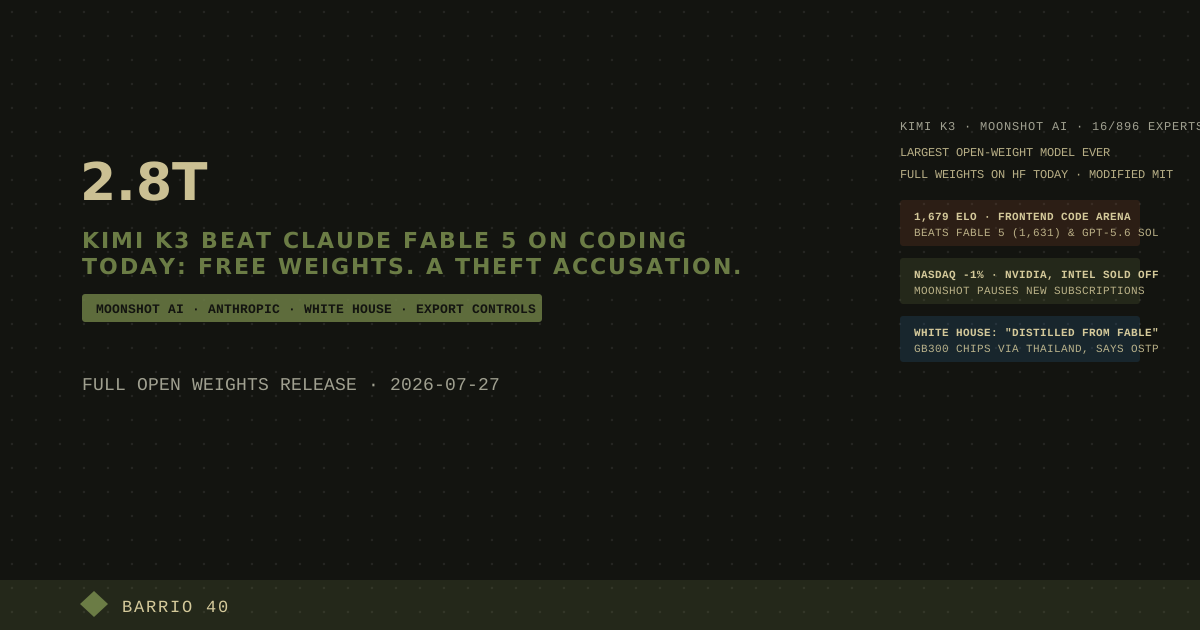
Kimi K3 is a sparse mixture-of-experts model: 2.8 trillion total parameters, but only 16 of its 896 experts activate on any given token, under 2% of the network, which is what makes a model this large runnable at all outside a hyperscaler's own data center. Moonshot paired that architecture with a 1-million-token context window and native vision, and trained the whole thing with quantization-aware fine-tuning so the weights could ship in MXFP4 format from day one — about 1.4 terabytes of storage, roughly a quarter of what FP16 weights at this scale would require. The company launched Kimi K3 through its API, app, and coding tools on July 16 and promised the full open weights, under a Modified MIT license on Hugging Face, "by July 27." That promise lands today. Moonshot's own guidance puts production-grade serving at 64 or more accelerators, but the practical self-hosting floor is lower: roughly 18 H100-class GPUs at 80GB each running the model at its native MXFP4 precision, which puts Kimi K3 within reach of any organization with a real multi-node cluster, not just labs with supernodes.
ONE LEADERBOARD, NOT THE WHOLE PICTURE
The headline number is real: on the Frontend Code Arena, Kimi K3 posted 1,679 Elo against Claude Fable 5's 1,631, GPT-5.6 Sol's 1,618, and GLM-5.2's 1,587 — Moonshot's model in first place, ahead of every closed frontier system on a benchmark that specifically measures how well a model writes and iterates on front-end code against human preference. It's a genuine result, not a cherry-picked one-off. But it isn't the whole ranking, either: on Artificial Analysis's broader Intelligence Index, which aggregates reasoning, knowledge, and general capability rather than one coding task, Kimi K3 scores 57 against Fable 5's 60 — Moonshot's model still trails on the measure that's supposed to summarize overall frontier standing. That's the same shape of claim this site flagged on July 21, when Alibaba's Qwen3.8-Max leaned on a single favorable benchmark to claim it was "second only to Fable 5" while trailing badly everywhere else the two models were directly compared. Kimi K3's coding win is a stronger and better-documented result than Qwen's was. It's still one leaderboard, not a verdict on which model is better overall.
WALL STREET TREATED IT LIKE DEEPSEEK, AGAIN
The market didn't wait for the weights to react to the capability. In the days after the July 16 API launch, the Nasdaq slipped roughly a percentage point and chipmakers absorbed the brunt of it, with Nvidia and Intel shares both selling off — a smaller echo of the shock DeepSeek's R1 sent through the same names when it demonstrated frontier-adjacent performance at a fraction of the assumed training cost eighteen months earlier. The subtext is the same each time: if a Chinese lab can field a model this capable, the market's assumption that US labs' massive compute spend buys a durable capability moat gets a little shakier. Moonshot's own operational strain underscored the demand side of that story — the company had to temporarily pause new subscriptions after usage pushed close to the limits of its serving capacity, a real bottleneck that today's open-weight release exists partly to route around by letting anyone with the hardware run the model themselves instead of queuing for Moonshot's API.
THE WHITE HOUSE SAYS THE WEIGHTS WERE STOLEN FIRST
Five days before today's release, the dispute stopped being about market share and became a formal accusation. White House Office of Science and Technology Policy director Michael Kratsios said the administration has information that Moonshot distilled Anthropic's Fable model to build Kimi K3 — using, in his description, a sophisticated internal platform built specifically to conduct large-scale distillation against US models, one designed to switch between multiple methods of access to avoid detection. Kratsios went further, alleging Moonshot acquired servers equipped with Nvidia's export-restricted GB300 system and accessed that same hardware class through servers located in Thailand. Treasury Secretary Scott Bessent said sanctions and Entity List designation are "on the table," and Undersecretary of State Jacob Helberg called the episode "a heist of invaluable American intellectual property." Moonshot has not responded to any of it.
THE ACCUSATION'S TIMING PROBLEM
The claim runs into an inconvenient calendar. Fable 5, the Anthropic model Moonshot is accused of systematically distilling into Kimi K3, has only been publicly available since July 1 — sixteen days before Kimi K3's own API launch. Distillation at the scale Kratsios described, sophisticated enough to require dedicated infrastructure and detection-evasion, is not typically a two-week job, and several independent analysts have said as much publicly, casting doubt on distillation as the primary explanation for Kimi K3's capability. This isn't the first round of this exact fight, either: Anthropic itself accused Moonshot, alongside DeepSeek and MiniMax, back in February of running roughly 24,000 fake accounts to generate about 16 million interactions with Claude for training purposes — an accusation Beijing dismissed at the time as groundless, the same word it's likely to reach for now. Nothing here rules out that some distillation happened; targeted extraction from a model API is a real and documented technique, and Moonshot has a motive to deny it regardless of the truth. But "systematic operation reaching banned chips in Thailand" is a much larger claim than the sixteen-day window supports on its own, and the administration hasn't yet published evidence that closes that gap.
WHAT THIS MEANS FOR TEAMS BUILDING ON AI
If you're evaluating Kimi K3 for real workloads, treat the two headline numbers as what they are: the Frontend Code Arena win is a legitimate reason to benchmark it against Fable 5 or GPT-5.6 Sol on your own front-end tasks, but the Artificial Analysis gap means you shouldn't assume that edge generalizes to reasoning-heavy or agentic work without testing it yourself. On infrastructure, the ~18x 80GB-GPU floor for MXFP4 serving is the number to plan against if self-hosting is on the table — it's within reach of a serious multi-node deployment, but it's not a weekend project, and Moonshot's own recommended production configuration is more than triple that. And on exposure: if your organization is in a regulated industry or does business with the US government, factor in that Kimi K3 now carries an active, unresolved federal distillation and export-control allegation attached to its provenance — that's a compliance conversation worth having before deployment, not after, regardless of how the underlying dispute between Washington and Moonshot eventually resolves.