GOLD EAGLE, THE 30-DAY WINDOW, AND WHAT COUNTS AS "COVERED"
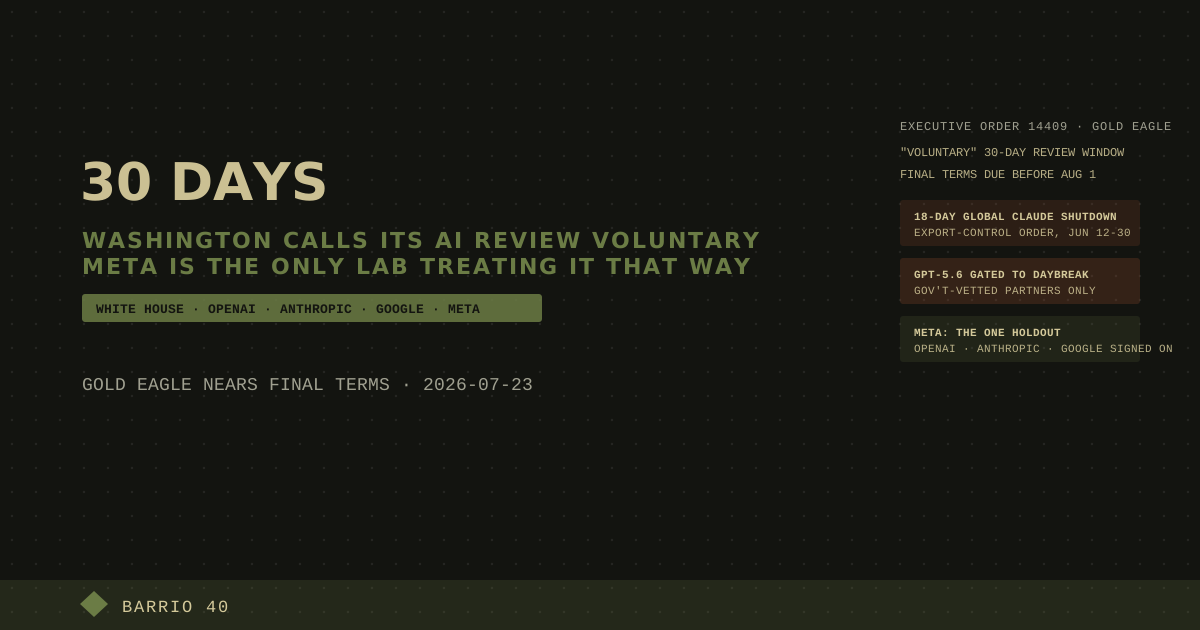
Executive Order 14409, "Promoting Advanced Artificial Intelligence Innovation and Security," directs federal agencies to build and maintain a classified benchmark identifying AI models with sufficiently advanced cyber capabilities — the ability to find, validate, or exploit software vulnerabilities at a level the government has decided warrants a look before the public gets one. A model that clears that threshold becomes a "covered frontier model." Its developer can then voluntarily hand federal evaluators up to 30 days of pre-release access — narrowed down from a 90-day window in an earlier draft of the order — before the model reaches anyone else, with the government also involved in choosing which outside "trusted partners" get an early look after that. CNBC's July 17 report gave the government side of this apparatus a name for the first time: Gold Eagle, a centralized body with the authority to sign off on who a lab brings into any model launch. The White House's own public description of Gold Eagle frames it as a vulnerability-coordination clearinghouse for the private sector. A White House official told CNBC that decisions on timing and scope of AI releases "rest entirely with the companies" — a characterization CNBC's sources inside those companies disputed.
WHAT "VOLUNTARY" HAS ALREADY COST
The clearest evidence that "voluntary" has teeth predates Gold Eagle's public name. On June 12, following an emergency alert from Amazon researchers over an advanced jailbreak vulnerability, the Commerce Department issued export-control directives that Anthropic said it lacked the real-time nationality-verification tooling to comply with — so it pulled both Fable 5 and Mythos offline globally rather than risk violating the order. The shutdown ran 18 days, ending June 30, when Fable 5 came back behind aggressive new safety classifiers that step hazardous coding prompts down to older model engines. Mythos never came all the way back: it remains restricted to government-vetted US critical-infrastructure customers under Anthropic's own Project Glasswing. OpenAI took a parallel path with GPT-5.6, holding its release back from general availability until the administration signed off on the partner list for Daybreak — the vulnerability-hunting platform this site covered at launch in May, then built on GPT-5.5 and open to partners including Akamai, Cisco, Cloudflare, and CrowdStrike. GPT-5.6 access under the revised terms is narrower: verified security use only, covering vulnerability triage, malware analysis, and patch validation, nothing broader.
THE ONE HOLDOUT
OpenAI, Anthropic, Google, Microsoft, and xAI have all agreed to Gold Eagle's terms in some form. Meta hasn't. The refusal lines up with where Meta's business already sits: a company that built its AI strategy on giving Llama's weights away has little to gain and a specific new cost to absorb from a program built around gatekeeping who sees a model first. For a lab shipping on its own calendar, a review window that can run 30 days and then extend further once "trusted partner" vetting stacks on top is a direct hit to a launch date that used to be Meta's call alone. It's also a bet that open weights make the gatekeeping largely moot in Meta's case — once a model ships open, there's no partner list left to control. Whether that bet holds depends on whether Meta ever ships something that clears Gold Eagle's classified cyber-capability threshold in the first place; nothing public confirms it has yet.
"A BACKDOOR LICENSING REGIME"
The order's text is unambiguous about what it isn't: no mandatory licensing, no preclearance, no permitting requirement. What isn't in the text is how the administration got Anthropic and OpenAI to comply anyway, weeks before Gold Eagle's terms were even finalized — export-control threats, delayed launch approvals, and direct calls from cabinet officials, according to reporting on both companies' June rollouts. Jonathan Iwry, a fellow at the University of Pennsylvania's Wharton Accountable AI Lab, put a name to the gap between the order's language and its effect: "we see the government repurposing existing legal authorities into what is effectively a backdoor licensing regime," built on existing Commerce Department power, with conditions that can shift without public notice. Google's Kent Walker, president of global affairs, described the framework taking shape as "an important step" — a company on the inside of the negotiation, choosing cooperative language, while a researcher outside it describes the same mechanism as licensing under a different name. Both descriptions can be accurate about the same set of facts; they just weigh the word "voluntary" very differently.
WHILE THE GATE WAS SHUT, THE CUSTOMERS WENT ELSEWHERE
The gating has a competitive cost that's now showing up in customer behavior, not just policy analysis. CNBC reported this month that Moonshot AI's Kimi K3 and Z.AI's GLM-5.2 — both open-weight, both outside any US review requirement — picked up ground while Daybreak and Glasswing sat behind partner approval. Coinbase cut its AI spend nearly in half by moving production workloads to GLM-5.2 and Kimi models, and security startup Armadin told CNBC it had specifically observed Moonshot's models improving on cybersecurity tasks — the exact category the US review program exists to slow down. That lands harder for Anthropic than for OpenAI: this site has already reported that Mythos's API pricing runs roughly double Claude Opus's and 82% above GPT's on a like-for-like basis, so a model that was already the expensive option in its category is now also the hardest one to get approved access to, at the same moment free, open-weight alternatives are demonstrably closing the capability gap.
WHAT THIS MEANS FOR TEAMS BUILDING ON AI
If your roadmap leans on a frontier lab's cybersecurity-tier model — Daybreak, Glasswing, or whatever Gold Eagle's finalized terms rename them to after August 1 — build in schedule slack for a review gate that isn't on any public calendar and can stack a "trusted partner" vetting step on top of its stated 30-day floor. Don't assume "voluntary" means optional in practice for a US lab that depends on Commerce Department goodwill for export licenses; June's 18-day Claude shutdown is the concrete example of how fast that leverage can bite. And don't assume routing security workloads to a Chinese open-weight model is a free hedge just because it's currently faster to procure — it trades a US policy risk for a different governance and supply-chain risk, not for no risk. The more durable move is architectural: keep whichever cybersecurity-capable model you're using behind an abstraction layer you control, so a gate that opens or closes in Washington doesn't take your own release schedule down with it.