A PREVIEW WITH THE PAPERWORK MISSING
Qwen3.8-Max-Preview is, on its own terms, a genuine engineering milestone: Alibaba's first multimodal model above one trillion parameters, handling text, images, video, and documents in a single 2.4-trillion-parameter system. It's already live and purchasable through Alibaba's Token Plan subscription, priced at 10% of what the company expects to charge once the model leaves preview, and Alibaba says open weights will follow "soon," without a date. What didn't ship on July 19 is everything a serious evaluation needs: no benchmark table listing which tests were run, no model card describing training data or safety evaluation, no license terms, no Hugging Face checkpoint, no disclosed mixture-of-experts configuration or active-parameter count, and no context-window or maximum-output specification. Reviewers who tried to independently verify the model's standing this week landed on the same conclusion from different angles — you cannot properly evaluate a system that shipped with no documented way to reproduce a single one of its claimed scores.
"SECOND ONLY TO FABLE 5" — GRADED BY WHOM?
The headline claim in Alibaba's launch materials is specific and confident: Qwen3.8-Max ranks second only to Claude Fable 5 among the models it benchmarked. That ranking has one source — Alibaba. Every performance line circulating this week traces back to the company's own internal evaluation runs, not a listing on Artificial Analysis, not a leaderboard position on LMArena, not a number any outside lab has reproduced. That alone would be worth flagging as marketing rather than measurement. But the specific evidence Alibaba's team has pointed to as the strongest data point behind the claim doesn't hold up on inspection, and the reason is more basic than "trust us."
THE SAME NUMBER, TWO DIFFERENT TESTS
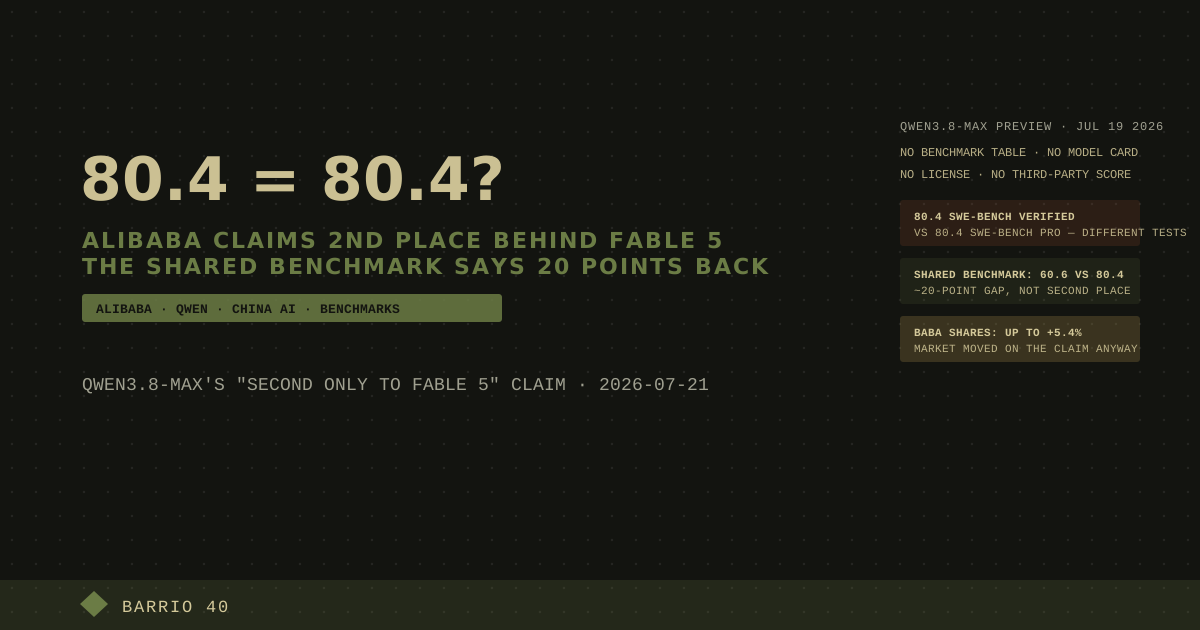
The comparison making the rounds pairs an 80.4 score from Qwen3.7-Max — Alibaba's prior flagship, not the new preview — on SWE-bench Verified against Fable 5's 80.4 on SWE-Bench Pro. Both numbers are 80.4. Neither test is the same benchmark: SWE-Bench Pro is a materially harder, more recent successor built specifically because SWE-bench Verified had become saturated by frontier models. Identical score, different difficulty, and the identical-looking number is doing real work to make two unlike things look comparable. On the one benchmark both companies have actually published a result for on equal footing — SWE-Bench Pro itself — Qwen3.7-Max scores 60.6, roughly 20 points behind Fable 5's 80.4. Qwen3.8-Max hasn't published a SWE-Bench Pro score at all. Until it does, the "second only to Fable 5" framing rests on a same-number, different-test comparison and a 20-point gap on the one test that actually lines up.
THE STOCK MOVED ANYWAY
None of that stopped the market from reacting. Alibaba's Hong Kong-listed shares gained as much as 5.4% on Monday, and its US-listed ADRs rose more than 3% in pre-market trading to around $119, though the move wasn't attributable to the model preview alone — Beijing's approval of Apple Intelligence features running on Alibaba's technology in China landed the same week and gave investors a second, more concrete reason to buy. The two stories reinforce each other in the market's read: a services deal with Apple that's real and signed, next to a model preview whose headline claim is unverifiable, both read by traders as evidence Alibaba's AI division is closing the gap on the frontier labs. Whether Qwen3.8-Max's benchmarks eventually support that read is a separate question from whether the stock moved on it.
THE PATTERN THIS WEEK IS PART OF
Qwen3.8-Max landed two days after Moonshot AI's Kimi K3 — a 2.8-trillion-parameter open-weight model whose July 17 release drew comparisons to DeepSeek's January 2025 shock and briefly rattled markets on the assumption that frontier-adjacent Chinese labs were closing the gap on US labs faster than priced in. Alibaba's preview reads as a direct answer to that moment: a bigger headline parameter count, a multimodal claim Kimi K3 doesn't make, and a ranking that puts Qwen ahead of Moonshot's model without saying so directly. The pattern across both releases is the same — genuine technical progress, announced with confidence that outruns what's been independently verified, in a news cycle that rewards being first over being checked. Neither model is bad; the question this week keeps raising is how much weight a launch-day claim should carry before someone outside the lab that made it has run the numbers.
WHAT THIS MEANS FOR TEAMS BUILDING ON AI
If you're evaluating Qwen3.8-Max for a production workload, the practical move is to wait for what doesn't exist yet — a published benchmark methodology, a model card, and an independent score from Artificial Analysis or LMArena — rather than budgeting around a preview-week ranking that Alibaba itself hasn't backed with a like-for-like test. That's not a China-specific caution: the same rule applies to any lab's launch-day claims, including the frontier US labs whose own benchmark selections are chosen to flatter their release. The concrete lesson from this week's number mix-up is narrower and more useful — when a vendor comparison cites a benchmark score, check the benchmark name, not just the number, before it enters a procurement deck. An 80.4 that means "harder test, real gap" and an 80.4 that means "easier test, no gap" look identical in a slide until someone asks which test produced it.