TWO DECISIONS, ONE ARTICLE 6 PLAYBOOK
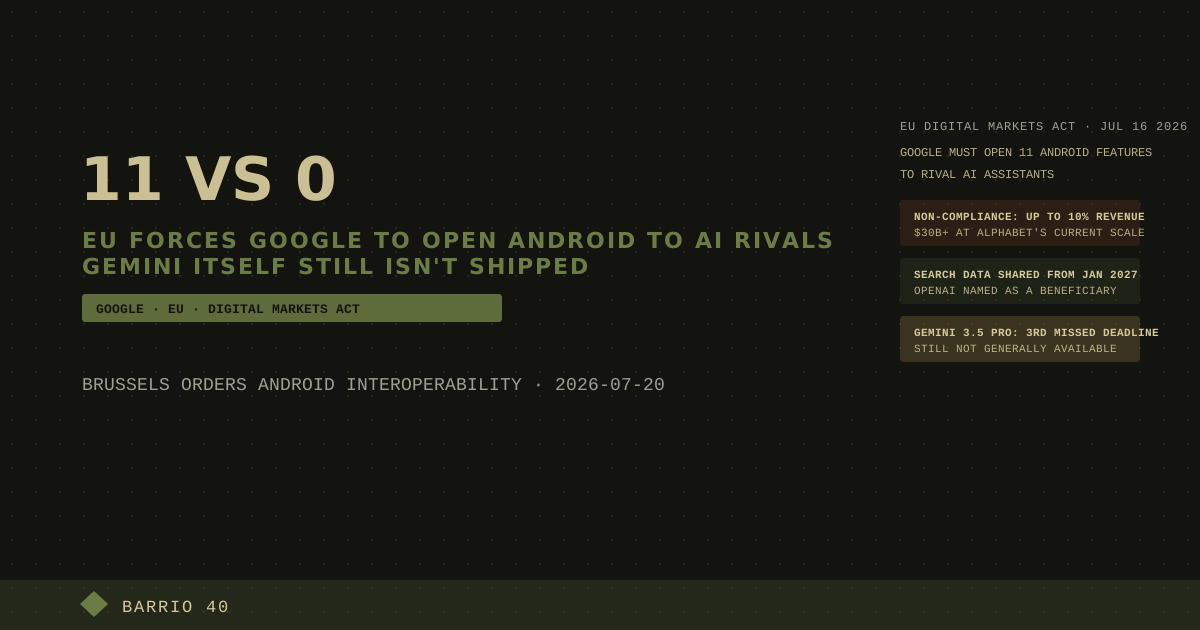
The Commission's July 16 action wasn't one ruling but two, issued under the specification mechanism the DMA uses when general obligations need to be translated into concrete engineering requirements. The first, under Article 6(7), covers interoperability: Google must, free of charge, give third-party software effective access to the hardware and software features Android controls — the same access Gemini gets by default. The second, under Article 6(11), covers Google Search: Google must grant rival search engines and AI chatbot providers access to anonymized ranking, query, click, and view data on fair, reasonable, and non-discriminatory terms. Both decisions follow six months of formal proceedings that opened in January 2026, after Brussels concluded Google's existing Android hooks and search-data walls were themselves a form of self-preferencing the DMA was written to stop. The Commission was explicit that the goal isn't picking a winner among AI assistants — it's making sure Gemini has to win Android users on merit rather than on system-level default access nobody else can get.
ELEVEN FEATURES GEMINI HAD AND RIVALS DIDN'T
The specification lists eleven defined Android capabilities that a rival AI assistant will now be entitled to use on equal footing with Gemini. The headline items: a competing assistant can register its own wake word at the operating-system audio-detection layer, the same layer that currently only recognizes "Hey Google," and it can claim the long-press home-button and navigation-handle gestures that today launch Gemini system-wide, regardless of which app is open. Beyond activation, the features extend into what the assistant can actually do once summoned — performing in-app actions on a user's behalf, such as booking a taxi or drafting a reply inside a messaging app, and answering contextual questions about a place the user recently visited, pulling from the same device signals Gemini already has standing access to. Google is not required to hand these features over immediately: most take effect with the next major Android release, with a hard deadline of August 1, 2027 for anything not shipped sooner.
THE SEARCH SIDE: FRAND TERMS, AND OPENAI BY NAME
The second decision moves faster. Starting in January 2027 — six months ahead of the Android deadline — Google must begin sharing anonymized Search data with eligible rivals, and the Commission named the intended beneficiaries explicitly enough that there's no ambiguity about the target: rival search engines and AI chatbot providers "including OpenAI." The mechanism is the same FRAND framework the EU has used to force interoperability in telecoms and standards-essential patents for decades — fair, reasonable, and non-discriminatory pricing, adjudicated by the Commission if the parties can't agree on terms themselves. In practice, that means any AI product that wants to ground its answers in real-time web signals — click data, query volume, ranking behavior — will be able to license a version of the data that today only Google Search collects at the scale needed to make it useful, without having to run their own crawl-and-index operation from scratch.
GOOGLE'S PUSHBACK, AND WHAT $30 BILLION BUYS
Google's president of global affairs, Kent Walker, responded publicly and unambiguously: "Today's decisions risk undermining vital privacy and security guardrails for millions of Europeans." His argument is that anonymization can't fully protect users once their search behavior is shared with companies Google doesn't control, and that opening system-level audio and gesture triggers to third parties creates new attack surface on a platform Google is still responsible for securing. Google has said it disagrees with both decisions and is expected to appeal to the EU courts — a process that historically takes years and does not pause the compliance clock while it runs. That clock matters: the Commission can open a separate non-compliance proceeding at any point if it judges Google's implementation inadequate, and the ceiling on that proceeding is up to 10% of Alphabet's total worldwide annual turnover, a figure that would clear $30 billion at the company's current revenue run rate — enough to make slow-walking compliance a materially worse bet than building the interoperability Brussels is asking for.
THE MODEL THE FIGHT IS SUPPOSEDLY ABOUT ISN'T READY
Here's the part that undercuts Google's own position without the Commission having to say a word: the Android default this ruling exists to unseat is a product that, three weeks past its own promised release, still isn't shipped. Gemini 3.5 Pro has now missed three consecutive internal deadlines — first slipping past its original June target, then past a rumored July 17 date that coincided with the WAIC conference in Shanghai, and it remains locked in a limited enterprise preview today. Google's public Gemini API documentation lists gemini-3.5-flash and gemini-3.1-pro-preview; Gemini 3.5 Pro itself is absent. Reporting has traced the holdup to coding-benchmark performance that fell short even after Google fed the rebuilt model updated training data in late June, and to an exodus of senior researchers — including Transformer co-inventor Noam Shazeer and Nobel laureate John Jumper — to OpenAI and Anthropic earlier this summer. Google is reportedly weighing a stopgap Gemini 3.6 Flash release to have something current on the shelf while Pro keeps slipping. The practical result: by the time Android's system-level assistant slot is genuinely contestable in 2027, rivals may be competing against a Gemini that has had an extra year to get its coding story straight — or Google may spend that year defending a default that isn't currently its best model anyway.
WHAT THIS MEANS FOR TEAMS BUILDING ON AI
Nothing here changes an Android integration roadmap today — the earliest deadline is January 2027 for search-data access, and the Android feature access doesn't land until the next major OS release at the earliest, with a backstop of August 2027. But it's worth planning around now rather than reacting to later: if your product depends on winning attention inside Android's assistant surface, the system-level defaults you're currently building workarounds for have a firm expiration date, and betting your UX on permanent platform asymmetry is a bet with a known end point. For teams evaluating frontier models in the meantime, the more immediate signal is the one sitting next to the ruling rather than inside it — a lab that's currently the target of an antitrust remedy built around defending its AI assistant's default status can't yet ship the model that assistant is supposed to run on. Vendor-selection decisions made this quarter are being made against GPT-5.6, Claude, Grok 4.5, and Kimi K3 for a reason: every week Gemini 3.5 Pro stays in preview is a week those contracts get signed elsewhere, regulatory tailwinds or not.