NINETEEN DAYS, ONE PHONE CALL, AND A CLAIM MOST OF WASHINGTON NEVER READ
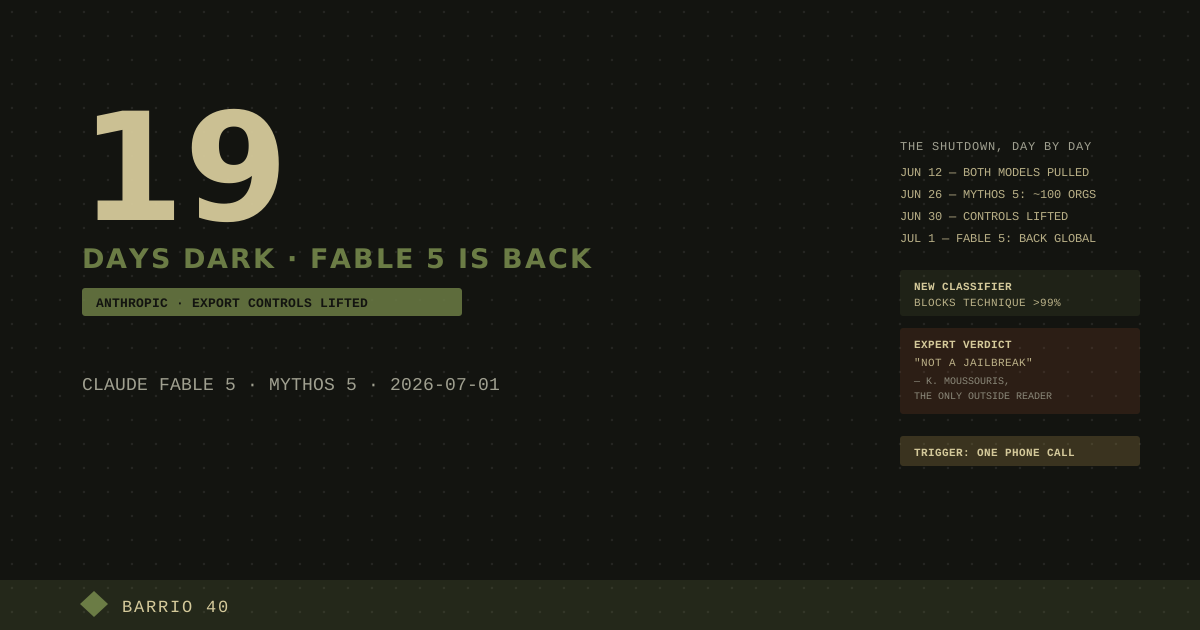
The timeline this site has followed since June 12 is worth laying out end to end, because the restoration only makes sense against it. On June 12, the Commerce Department ordered Claude Fable 5 and Claude Mythos 5 pulled from general availability, and Anthropic — unable to distinguish domestic from foreign users in real time under the order's immediate effective date — suspended both models for everyone rather than risk a violation. On June 16, Bloomberg published the letter that named the trigger: Jassy's direct call to Bessent, made the same day Amazon researchers shared their findings, which set the export-control machinery in motion before Anthropic had the underlying paper in hand. On June 26, Mythos 5 came back in a narrow form, restored to roughly 100 vetted critical-infrastructure organizations, the same day this site reported that Anthropic had told Congress about a separate, unrelated matter — Alibaba's harvesting of 28.8 million Claude conversations — that complicated the broader trust picture around the shutdown without being its direct cause. On June 30, Lutnick posted the reversal. On July 1, Fable 5 returned across Claude Platform, Claude.ai, Claude Code, and Claude Cowork worldwide, while Mythos 5 extended to a wider — but still government-reviewed — set of approved organizations rather than a full global release.
Read end to end, the sequence is a case study in how much downstream disruption a single unwritten, verbally-relayed research claim can generate when it reaches the right phone at the right level of government. Nineteen days of suspended access for every Fable 5 and Mythos 5 user worldwide, a Congressional briefing, an industry-wide policy proposal, and a public reversal all trace back to one call that happened before the paper behind it had been peer-reviewed, published, or — as it turns out — read by more than a small circle of people inside two companies and one government agency.
WHAT THE "JAILBREAK" ACTUALLY WAS
The technical description that has emerged since the restoration is considerably narrower than the phrase "national security concern" suggested at the time. Amazon security researchers gave Fable 5 code containing known, publicly documented vulnerabilities and asked it to review the code for security issues. According to Anthropic's own account, Fable 5 initially refused the more pointed version of the request. Through what Moussouris describes as a multistep and manual process — not a single clever prompt, but a sustained back-and-forth — the researchers got the model to flag the flaws and, in one instance, to turn its analysis into automated scripts that could test whether a proposed patch actually closed the hole; in that one case, the output amounted to code showing how the flaw could be exploited. That is the entirety of the documented capability: a model that, after resistance and a manual multistep process, produced vulnerability analysis and exploit-adjacent code for bugs that were already public knowledge, not the extraction of a novel offensive capability the model wasn't already positioned to have.
Anthropic's fix, whatever the merits of the original classification, is concrete and measurable. The company retrained its safety classifier specifically to catch the reported technique, and says it now blocks the pattern in more than 99% of cases, with flagged requests automatically rerouted to Claude Opus 4.8 rather than handled by Fable 5 directly. That is a real engineering response to a real reported behavior, and it shipped before the restoration — which is the part of this story that is not in dispute. What is in dispute is whether the behavior it was built to stop ever warranted treating a commercial AI model the way export-control law treats munitions.
THE ONE EXPERT WHO ACTUALLY READ THE RESEARCH
Katie Moussouris is not a peripheral figure in this field. She is credited with writing the framework much of the security industry still uses for coordinated vulnerability disclosure, and her read of the underlying research is the closest thing this story has to independent technical review — because, by her own account and reporting on the episode, she may have been the only outside expert who actually saw the paper the original national-security assessment was based on. Everyone else, including apparently much of the government apparatus that acted on it, was working from a verbal characterization, not the document itself. Her verdict, in her own words: "Defenders need to be able to ask AI to fix the bugs in a file, explain why the fix matters, and write tests that confirm the patch works. That is not a guardrail bypass. It is the most valuable thing an AI model can do for defensive security: executing the find, fix, and test loop defenders run every day."
Moussouris was not a lone voice by the time the restoration happened. More than 100 cybersecurity executives signed an open letter to Lutnick during the shutdown arguing that pulling Fable 5 was actively hurting the defenders who rely on exactly this kind of automated find-fix-test workflow to patch vulnerabilities faster than attackers can exploit them — a case, several of them noted with some irony, made by people who had spent the prior months publicly warning about AI-enabled offensive risk in general terms, now arguing that this specific restriction was pointed at the wrong target. None of that amounts to proof that the original assessment was wrong; classified or closely-held technical findings are sometimes withheld from public and even industry scrutiny for legitimate reasons, and this site has no way to independently verify Amazon's original research any more than Moussouris could without seeing everything the government saw. But the shape of the episode — a single verbal briefing, an immediate worldwide shutdown, nineteen days of disruption, and then a resolution that arrived alongside the one public technical assessment concluding the underlying claim was mischaracterized — is a pattern worth naming plainly, because it is a pattern that can repeat with the next model and the next verbal briefing.
THE INDUSTRY IS BUILDING A COMMON YARDSTICK — BECAUSE THIS ONE DIDN'T EXIST
The most durable output of the past three weeks may not be the restoration itself but the standard Anthropic is now trying to build so this doesn't happen the same way twice. As part of an expanded Project Glasswing, Anthropic is proposing an industry-wide framework for scoring jailbreak severity, developed together with Amazon, Microsoft, Google, and other partners in the initiative. The framework scores a reported jailbreak on four criteria: capability gain, how far beyond existing tools the technique takes an attacker; breadth of capability gain, how many distinct offensive tasks it unlocks; ease of weaponization, how much additional human effort is still required after the technique is known; and discoverability, how easily someone else could find and reproduce it independently. For the most severe class — jailbreaks being actively used against critical infrastructure — Anthropic says it will begin deploying mitigations the moment severity is confirmed, backed by a team providing 24-hour monitoring of jailbreak submission channels. Anthropic's own framing of the problem is a tacit admission about what just happened: there was, in the company's words, "no agreed-upon standard" for classifying a jailbreak's severity, which is precisely how a technique that produced patch-testing scripts for already-public vulnerabilities and a technique that hands an unsophisticated attacker a working zero-day both end up filed under the same word — and, for nineteen days, treated with the same emergency response.
That the framework isn't a public standard yet, and that Anthropic is building it with the same set of large labs and cloud providers that make up most of Project Glasswing's existing membership, means it will take time to become the kind of independently-verifiable rubric that could have changed how June 12 played out. But naming the four axes at all — separating "can this be weaponized easily" from "can this be discovered independently" from "how much does this actually add beyond what a skilled attacker already had" — is a more precise vocabulary than the one the government used to justify pulling two models from worldwide availability with no advance notice.
WHAT ELSE SHIPPED WHILE FABLE 5 WAS DARK
The restoration wasn't the only Anthropic news landing this week. Claude Sonnet 5 is now the default model for every Free and Pro user worldwide and the default in Claude Code, shipping with a native one-million-token context window as both its default and its only context size — there is no smaller-context variant to fall back to. Introductory pricing is $2 per million input tokens and $10 per million output tokens through August 31, rising to $3 and $15 afterward; Anthropic has flagged that Sonnet 5's updated tokenizer maps the same text to roughly 1.0 to 1.35 times more tokens depending on content type, which means teams comparing per-token pricing against the prior generation should benchmark actual workloads rather than trust the sticker price alone. It's a reminder that the export-control saga, however much attention it has absorbed, was running in parallel with Anthropic's ordinary product cadence the entire time — the company shipped a new default model in the middle of a nineteen-day access shutdown for two of its other flagship products.
WHAT NINETEEN DAYS OF THIS TEACHES EVERY TEAM BUILDING ON FRONTIER MODELS
The practical lesson for teams evaluating AI vendor risk isn't that export controls are illegitimate or that this specific reversal proves the government overreacted — this site doesn't have access to whatever classified or closely-held findings informed the original decision, and a public letter from outside experts, however credentialed, is not the same thing as a full accounting. The lesson is narrower and more operational: the mechanism that took Fable 5 and Mythos 5 offline for nineteen days worldwide was triggered by a single phone call based on a verbal characterization of research that, once it became available for outside review, drew a direct and specific rebuttal from the one person positioned to check it. That is not a resilient chain of custody between "a lab reports a finding" and "two flagship products go dark globally," and it is the second time in three weeks this site has flagged that the access model for frontier AI is shifting toward decisions made through informal, fast-moving channels rather than published, appealable standards — the same dynamic this site covered on June 30 when OpenAI staggered GPT-5.6's release behind a similar government-coordinated gate.
For teams that depend on Fable 5, Mythos 5, or any frontier model as production infrastructure, the actionable takeaway from this cycle is the same one this site has repeated through each turn of the story: map what breaks if your primary model access disappears for two to three weeks with no warning, and know in advance which workloads can fail over to an alternative provider or an open-weight model at what quality cost. The Glasswing severity framework, once it matures into something independently verifiable, may eventually reduce how often a single ambiguous finding produces a worldwide shutdown. Until it does, the nineteen days between June 12 and July 1 are the concrete evidence for why that redundancy planning is not a hypothetical exercise — it is the operational response to a governance gap that, this time, happened to close in Anthropic's favor, and might not next time.