XI'S FIRST WAIC APPEARANCE, AND WHAT HE USED IT FOR
The World Artificial Intelligence Conference has run in Shanghai every year since 2018, and until Friday, Xi Jinping had never shown up to it in person. This year's edition — running July 17 to 20 under the theme "AI Partnership for a Brighter Future," with more than 140 forums, over 1,100 exhibitors and roughly 1,400 guests packed into six sections spanning conferences, exhibitions, awards, and talent recruitment — got a keynote from the head of state himself. Xi told the audience that "with AI advancing at a staggering speed, we must ensure its development is for the positive, for good, and for humanity," and framed the rest of his remarks around a call for binding oversight rather than open acceleration: laws, technological monitoring, early-warning systems and emergency-response mechanisms designed, in his words, "to ensure AI is always under human control." He described the approach as "people-centric." None of that positions China as the deregulated alternative to Western AI governance — it positions Beijing as offering a different governance stack, built and hosted on its own terms, to the roughly two-thirds of the world that neither the EU AI Act nor the G7's Hiroshima Process was written with in mind.
THE TREATY: WAICO'S TWENTY-NINE FOUNDING MEMBERS
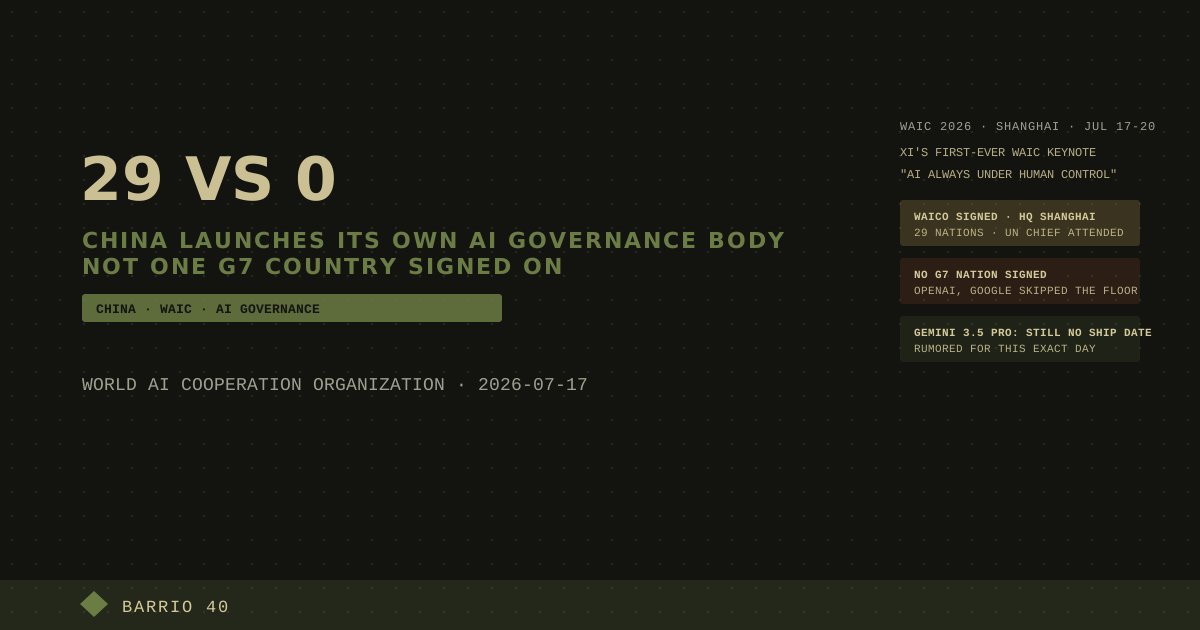
The institutional substance of the week didn't happen on the keynote stage — it happened the day before, when 29 countries signed the agreement establishing the World AI Cooperation Organization, an independent intergovernmental body headquartered in Shanghai and, per its founding language, guided by United Nations Charter principles. China's foreign minister, Wang Yi, signed on Beijing's behalf; UN Secretary-General António Guterres attended the ceremony, lending the body a degree of institutional legitimacy that Beijing was clearly counting on. The signatory list skews toward Asia and Africa — roughly 12 and 10 countries respectively — and includes China, Russia, Belarus, Serbia, Cuba, Brazil, Venezuela, Kazakhstan, Laos, Pakistan and Indonesia. WAICO's stated mission is to promote "beneficial, safe, and fair" AI development and international cooperation on AI governance. Structurally, it follows a playbook China has run before: the Shanghai Cooperation Organization did the same thing for security and economic cooperation two decades ago — a multilateral body China co-founded, shaped, and hosted, that gave countries outside the Western alliance system a seat at a table built specifically for them.
THE PITCH TO THE GLOBAL SOUTH
Xi's keynote wasn't just rhetoric — it came with commitments attached. China announced 5,000 training and seminar opportunities in AI for developing countries, and said it would build international AI application cooperation centers with ASEAN, the League of Arab States, the African Union, the Community of Latin American and Caribbean States, the Shanghai Cooperation Organization, and BRICS. That list of partners is the pitch in miniature: none of those blocs has a formal seat at the AI governance tables the US, EU, and UK have spent the past three years building. WAICO is the institutional extension of a policy push China has been running since 2023 — the Global AI Governance Initiative, a UN General Assembly resolution on AI capacity-building that passed by consensus, an "AI Capacity Building Action Plan for Good and for All," and now an "AI Plus" International Cooperation Initiative. Individually, each of those is a paper commitment. Stacked together and now backed by a treaty organization with 29 signatories and a UN Secretary-General standing at the signing table, they read as a genuinely sustained multi-year campaign, not a one-conference stunt.
WHO ISN'T IN THE ROOM
The list of countries that didn't sign is at least as informative as the list that did: no G7 economy — not the US, not any EU member, not the UK, Japan, or Canada — put a signature on the WAICO treaty, and analysts covering the summit were blunt about why: no major Western government is going to hand a China-headquartered body a broad mandate over both AI promotion and AI safety governance while Beijing simultaneously runs one of the most extensive domestic AI-surveillance and social-credit infrastructures in the world. That's the paradox Western critics keep pointing back to — a government asking to co-write global rules on AI safety and fairness while deploying the technology domestically in ways those same rules would, on paper, restrict. The corporate absence tracked the political one: neither OpenAI nor Google put up a booth on the exhibit floor, out of roughly 1,100 exhibitors and more than 300 product debuts, which is as close to a scorecard of the current geopolitical alignment in frontier AI as any conference guest list is likely to produce this year.
THE TIMING ACCIDENT: A GOVERNANCE BODY SHIPPED ON SCHEDULE, A MODEL DIDN'T
The date is doing more work here than coincidence usually allows. Multiple outlets had spent the past month reporting that Google's Gemini 3.5 Pro — rebuilt on an entirely new pretraining run after Gemini 3.5 Flash shipped alone at I/O in May, reportedly carrying a 2-million-token context window and a Deep Think reasoning mode gated behind the $250-a-month Ultra tier — was targeting a July 17 release. As of this week it still hadn't shipped: Bloomberg reported the holdup traces to disappointing coding-benchmark results after the rebuild, with Google feeding the model updated training data in late June that reportedly didn't move the needle enough to justify a launch. Google has published no official model card, pricing page, or release note for Pro as of this writing. Set against that, WAICO's signing ceremony went off exactly as scheduled, with a head of state on stage and a UN Secretary-General as witness. One story is about a frontier lab that couldn't hit its own publicly rumored ship date on a benchmark race everyone already assumed it would eventually win. The other is about a government executing a multi-year institutional strategy precisely on schedule. Both are true in the same week, and they say very different things about where each side of this competition is actually strong.
WHAT THIS MEANS FOR TEAMS BUILDING ON AI
The practical takeaway isn't that WAICO immediately changes what model you should call from your stack — it's that the AI industry is now visibly building two parallel governance tracks at once, and teams operating in markets aligned with either bloc need to know which one applies to them. If your customers, data residency requirements, or go-to-market plans touch Belt-and-Road-aligned economies — much of Southeast Asia, Africa, Latin America, or Central Asia — WAICO's eventual technical standards and certification processes, however nascent today, are worth tracking the same way you'd track an emerging regional data-protection regime, because those 29 signatories represent real regulatory jurisdictions, not just conference attendees. For everyone else, the more immediate lesson is about vendor timelines: "rumored for July 17" and "shipped on July 17" are different claims, and a roadmap built around an unconfirmed frontier-model release date is a roadmap built on sand. Plan launches, evals, and vendor-switch decisions around confirmed model cards and pricing pages — not around the release date a dozen blogs converged on repeating from the same anonymous sourcing.