WHAT HAPPENED IN THE ROOM
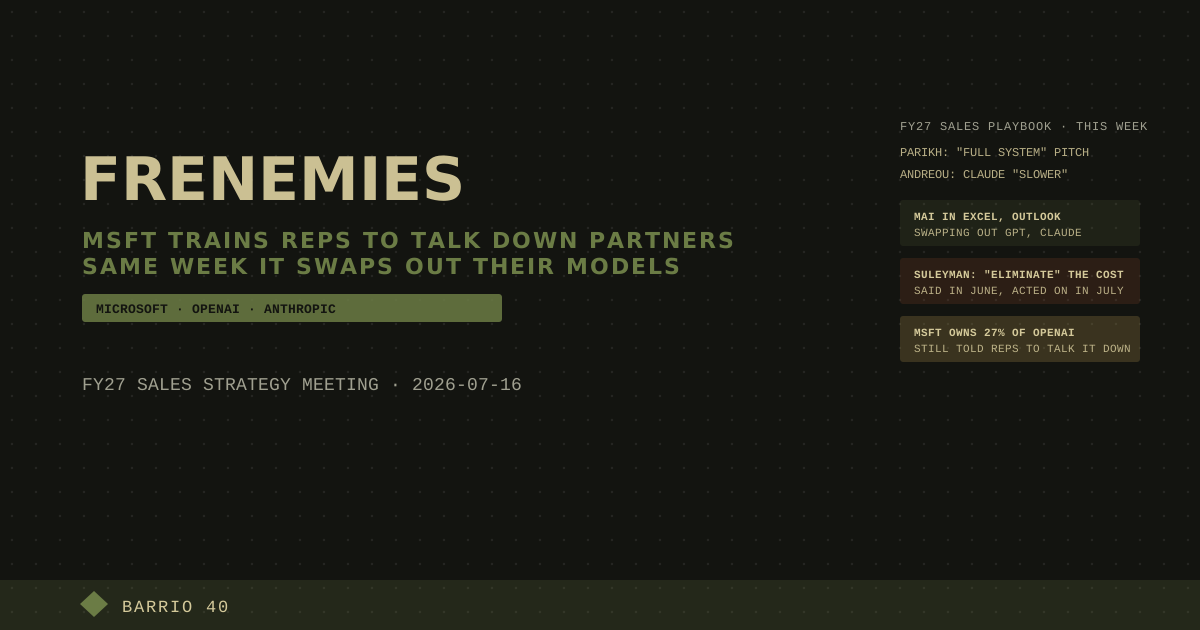
The meeting was billed internally as Microsoft's FY27 sales-strategy session, and by all accounts it stayed on that script for most of the room — until the topic turned to the two AI labs Microsoft has spent the past decade bankrolling. CoreAI chief Jay Parikh, who leads the group Satya Nadella built specifically to consolidate Microsoft's AI infrastructure, told reps that "everyone else is selling parts — we're selling the full end-to-end system. That's the story that we all need to get out there and tell in FY27." Jacob Andreou, the 33-year-old executive Nadella tapped in March to fix Copilot, went further, delivering a direct product comparison against Anthropic's Claude — the model that has been running much of Microsoft 365 Copilot's actual output — arguing it was slower, less accurate, and lacked the security integrations Microsoft's own models get for free inside Office. Neither talking point is unusual on its own; every vendor trains reps to say the competition is worse. What makes this one notable is who Microsoft was describing as the competition.
THE SWAP NOBODY HAD TO ANNOUNCE
The sales meeting wasn't an isolated jab — it's the marketing layer sitting on top of a product change that had already been underway for weeks. Microsoft's in-house MAI models are now handling tens of thousands of requests per week inside Excel and Outlook, quietly substituted in for OpenAI's and Anthropic's models on a growing slice of Copilot traffic. It's still a small fraction of total volume today, but the direction is deliberate, not incidental: Mustafa Suleyman, Microsoft's AI chief, said as much in June without much hedging — "we pay a lot of money to Anthropic, so our goal is to reduce and ultimately eliminate that cost." MAI models are also live inside GitHub Copilot, and a proprietary transcription model is expected in Teams soon. Microsoft has already shipped seven MAI models this year, including MAI-Thinking-1, its first reasoning model, which the company claims matches Claude Sonnet 4.6 and Opus 4.6 on coding tasks in its own human evaluations — the same benchmark territory Andreou was arguing against in the sales deck days later.
THE DEAL THAT CLEARED THE WAY
None of this repositioning was possible under the terms Microsoft and OpenAI operated under for most of the past decade. That changed on April 27, when the two companies rewrote their partnership: Microsoft's exclusive license to OpenAI's models ended, freeing OpenAI to sell its full product line on any cloud platform, and the "AGI clause" that had given Microsoft IP rights over OpenAI's technology until it reached artificial general intelligence was erased entirely. Microsoft stopped owing OpenAI a revenue share under the new terms, though OpenAI's payments to Microsoft continue through 2030, and Microsoft's license to OpenAI's models and products now runs through 2032. The amendment reflected a market that had already moved on: in February, AWS became OpenAI Frontier's exclusive third-party cloud distributor, ending any pretense that Azure was the only place to run OpenAI's models. Strip away the diplomatic framing, and the April rewrite is what let Microsoft build and market a competing product line without breaching the contract that used to bind it to being OpenAI's primary distribution partner.
THE SHAREHOLDER PROBLEM
What makes Microsoft's position structurally strange is that it isn't just a customer of OpenAI and Anthropic — it's OpenAI's largest outside shareholder, holding roughly 27% of the company after committing more than $13 billion since 2019. That stake was valued around $135 billion in October 2025 and, by some estimates, has since risen toward $228 billion following OpenAI's March round at an $852 billion valuation — though Anthropic's own private valuation has since overtaken OpenAI's entirely. Microsoft's incentives now pull in two directions at once: as an equity holder, it profits when OpenAI's models are good enough to win customers and grow revenue; as a product company running Copilot, every query it routes to OpenAI's or Anthropic's API instead of its own MAI model is a cost it books against its own margin. Telling sales reps to cast doubt on the very labs it holds a nine-figure stake in isn't a contradiction Microsoft is likely to resolve cleanly — it's a tension baked into being simultaneously an investor, a distributor, and now a direct competitor to the same two companies.
WHERE THE PRICING IS HEADED
The economics behind the sales training point toward a specific commercial structure, not just a preference. One pricing path Microsoft is reportedly weighing would make the cheaper MAI models the default inside Copilot, with OpenAI's and Anthropic's models available only as a paid premium add-on layered on top. Under that structure, Microsoft would effectively become a markup reseller of its own equity partners' technology — passing its OpenAI and Anthropic API costs straight through to customers with a surcharge attached — while positioning the free, in-house alternative as the one its own sales force has just spent a fiscal year describing as more secure and better integrated. It's a coherent business plan. It also means the "which model is better" argument Andreou made in the sales deck doubles as the argument for why customers should pay extra to get the models Microsoft is telling them not to trust by default.
WHAT THIS MEANS FOR TEAMS BUILDING ON AI
The lesson here generalizes well past Microsoft, OpenAI, and Anthropic specifically. Any platform that resells more than one model vendor — Copilot, Azure AI Foundry, or the equivalent inside any other multi-model product — has a direct cost incentive to default your traffic toward whichever model it owns outright, and a marketing incentive to frame the alternatives as worse, sometimes in the same fiscal year it's quietly rerouting requests away from them. Neither incentive is disqualifying on its own, but neither is neutral either. Teams building on a reseller platform should pin the model they've actually evaluated rather than trust a vendor's default, watch release notes for silent routing changes the way you'd watch for a dependency bump, and treat a platform vendor's internal benchmark claims about a model it also resells for a fee with the same skepticism you'd apply to a used-car dealer's assessment of the competing lot down the street.