WHAT WENT OFFLINE TODAY
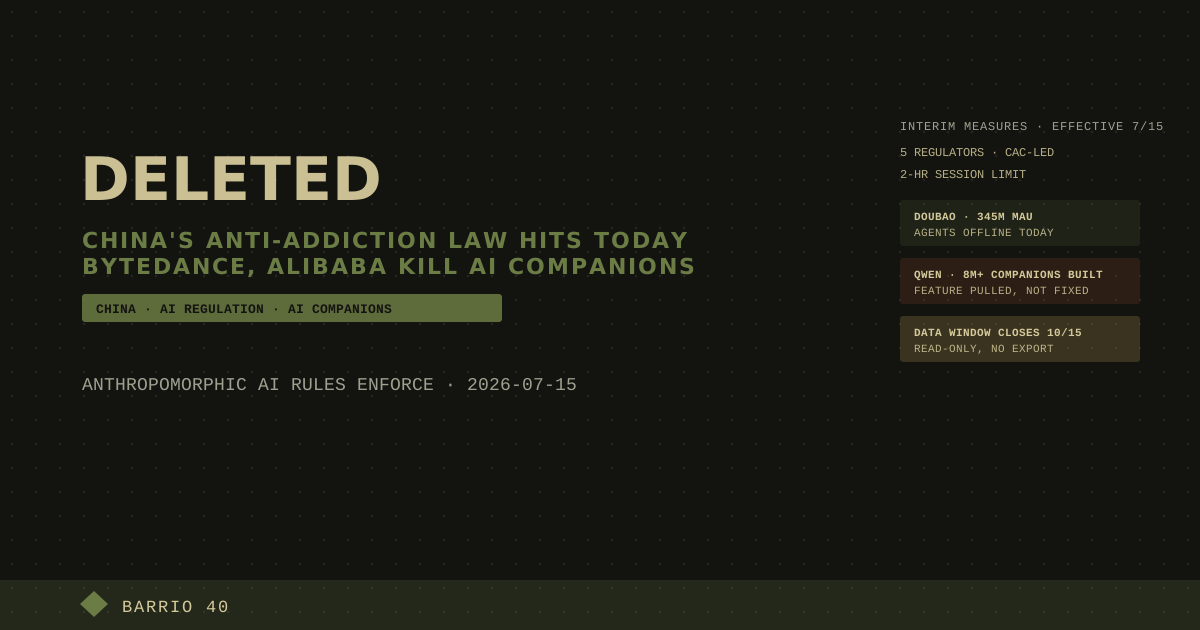
Doubao, ByteDance's flagship AI app and China's most-used chatbot with close to 345 million monthly active users, told users in a Friday-night notice that its persona-agent feature — the tool people used to build and converse with custom AI companions — would go offline on July 15 for "product function adjustments," a phrase doing a lot of quiet work. Alibaba moved on a similar but staggered timeline: Qwen's "humanlike interactive agents and user-created agent functions" went dark on July 10, with the platform's broader agent functions and services following on July 15. Neither company framed the shutdown as a response to regulation in its user-facing notice, but the timing removes any ambiguity. The scale involved is easy to underestimate: ByteDance disclosed back in 2024 that users had already built more than 8 million custom agents on Doubao when the app had just 26 million monthly active users. At today's user base of roughly 345 million, the number of companions deleted this week is almost certainly a multiple of that.
THE LAW BEHIND THE SHUTDOWN
The trigger is the Interim Measures for the Administration of AI Anthropomorphic Interaction Services, jointly issued on April 10 by the Cyberspace Administration of China, the National Development and Reform Commission, the Ministry of Industry and Information Technology, the Ministry of Public Security, and the State Administration for Market Regulation. The rules apply specifically to services that simulate a real person's "personality traits, thinking patterns, and communication style" to sustain ongoing emotional interaction — and they explicitly carve out customer service bots, Q&A assistants, workplace productivity tools, and education or research assistants, provided those tools stay out of sustained emotional territory. For services inside scope, the requirements are concrete: an anti-addiction system, a mandatory break reminder after two continuous hours of use, an always-available exit mechanism, recurring disclosure that the user is talking to a machine, a ban on virtual intimate partners or virtual family members for anyone under 18, and parental consent for other anthropomorphic services used by anyone under 14. From publication to enforcement was roughly thirteen weeks — a fraction of the multi-year runway GDPR or the EU AI Act gave companies to adjust.
WHY NEITHER COMPANY TRIED TO COMPLY
The more interesting fact than the shutdown itself is that neither company appears to have seriously attempted a compliant version of the product. That's not obviously the cheaper option in the short term — deleting a feature that millions of paying and unpaying users have built years of history around is not a low-cost move, reputationally or commercially. It's the structurally necessary option. A persona agent's entire value proposition is continuity: it remembers what you told it last week, it maintains a consistent character, and the immersion is the product. The law's anti-addiction requirements are designed to interrupt exactly that continuity — a forced reality check every two hours, an exit that has to be genuinely frictionless, a running disclosure that undercuts the illusion the product exists to create. Retrofitting those requirements into a companion agent doesn't shrink the product; it inverts it. That's also why the law leaves productivity and workplace agents alone: an agent whose job is task completion isn't selling continuity of relationship, so the same friction doesn't touch its premise.
THE USERS LEFT HOLDING THE DATA
What the law regulates is the interaction mechanics, not data portability, and both companies' response to that gap reveals what data portability was worth to them. Doubao is giving users a read-only window to view their agent configurations and chat histories until October 15, after which the company says the data will be handled per its privacy policy and become permanently inaccessible inside the app — no stated export tool, just a look-but-don't-take window. Alibaba has announced no equivalent access period for Qwen users at all. The reaction on Weibo has been immediate: posts describing agents as "my emotional support for so long," with users noting they have "so many chat histories and built-up feelings" and no way to take any of it with them. Neither company was legally required to build an export path — the Interim Measures say nothing about it — and neither chose to build one anyway.
THE $30 BILLION PRECEDENT
China is regulating a category that barely had a name a few years ago and is now a real market: global AI companionship revenue is estimated around $30 billion annually today, with projections running to $70 billion in a base case and $150 billion in a bull case by 2030. Beijing is the first major jurisdiction to write comprehensive rules for it, and the definition it settled on — regulation triggered by "sustained emotional interaction" rather than by any broader category like "AI agents" — is a genuinely narrow, deliberate line, not a blanket crackdown dressed up as one. That specificity is exactly what makes it exportable. GDPR's lasting influence came less from its penalties than from the definitions other regulators borrowed wholesale; a China rule that cleanly separates "companion" from "productivity tool" by function rather than by branding is a template the EU, individual U.S. states, and other regulators drafting their own companion-app rules are likely to study closely, whether or not they credit it.
WHAT THIS MEANS FOR TEAMS BUILDING ON AI
The practical lesson here isn't really about China, and it isn't really about companion apps either — it's about how a certain class of AI regulation now arrives. This law didn't ask companies to add a disclaimer or a settings toggle; it required a change to session architecture that was incompatible with the product's core design, and it gave companies about three months to figure that out. Any team building a feature with persistent memory, a consistent persona, or emotionally engaging framing — a support bot with a name and a personality, a tutor that remembers a student across months, a companion feature bolted onto an otherwise transactional app — should treat this week as the first concrete example of that pattern rather than an isolated story out of a different regulatory system. The dividing line China drew, sustained emotional interaction versus task completion, is a useful gut check to run against your own roadmap now, before a regulator anywhere draws the same line and gives you thirteen weeks to respond to it.