THE LETTER: EIGHTY-EIGHT WORDS, TWO HUNDRED SIGNATURES
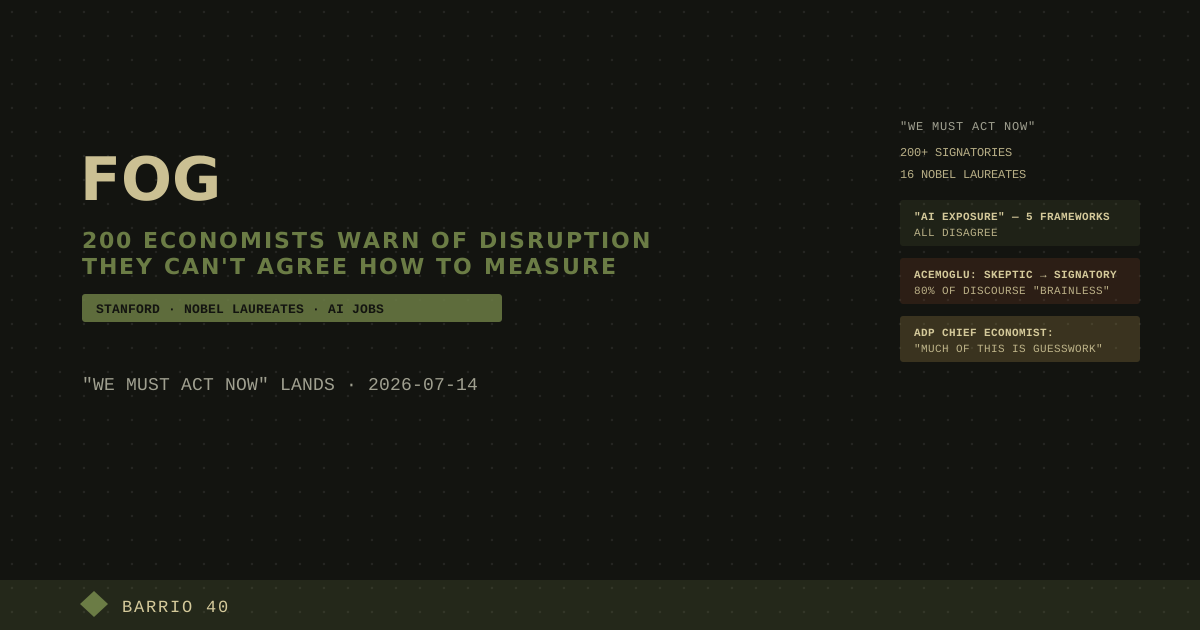
The statement itself is short enough to read twice before finishing this paragraph: "AI may become radically more powerful over the next 10 years. This could drive an unprecedented transformation of our economy, larger than the Industrial Revolution, but unfolding over a vastly shorter time frame. It could bring risks, including large-scale job displacement, as well as opportunities such as major gains in living standards." Titled "We Must Act Now: A Statement on AI's Transformation of the Economy," it was organized by Stanford's Digital Economy Lab and coordinated by economists Erik Brynjolfsson, Ajay Agrawal, Anton Korinek, and Tom Cunningham, then published to a dedicated site where the signatory count continues to climb past its initial 200. Sixteen of those signatories hold Nobel Prizes, including Joseph Stiglitz, Daron Acemoglu, and Simon Johnson. The corporate roster runs through both sides of the AI industry: Google AI lead Jeff Dean, Anthropic cofounder Jack Clark, OpenAI finance chief Sarah Friar, former Google CEO Eric Schmidt, and LinkedIn cofounder Reid Hoffman all signed, alongside Yoshua Bengio, one of deep learning's three foundational researchers. Notably absent from the list, based on current reporting: Dario Amodei and Sam Altman themselves, whose companies' chief economists signed in their place.
THE ACEMOGLU REVERSAL
The most interesting name on the list is not the most famous one. Acemoglu, a 2024 Nobel laureate, has spent the past several years as the field's most credentialed skeptic of AI productivity claims, telling Fortune as recently as June that he considers roughly 80% of the current AI-and-capitalism discourse "brainless" and estimating that AI will add only about 0.55% to total factor productivity over the next decade — a small fraction of the gains Wall Street models routinely assume. That skepticism was never about whether AI works; it was about whether the economic story built around it holds up. His signature on a letter warning of imminent, large-scale disruption is therefore not a case of an alarmist joining other alarmists. It is a case of one of the discourse's most rigorous doubters saying, in effect, that recent model capability has moved the near-term risk far enough that skepticism about the hype no longer implies comfort about the timeline. Simon Johnson, his frequent co-author and fellow 2024 Nobel winner, signed for the same reason.
THE PROBLEM THE LETTER DOESN'T MENTION
Nowhere in the 88 words is the word "exposure" defined, which is a problem because "AI exposure" is the load-bearing concept underneath nearly every labor-market study the letter's own signatories have published. Torsten Slok, Apollo's chief economist, used a Daily Spark note the same week to lay out why that matters: there are currently at least five distinct methodologies in circulation for measuring how exposed a given job is to AI, and they were built to answer different questions. One tracks what people actually ask Claude to do, drawn from real conversation logs — the closest thing to ground truth for how the technology gets used today. A second does the same with Microsoft Copilot logs. A third asks human experts to judge, task by task, which skills AI is theoretically capable of replacing, regardless of whether anyone is using it that way yet. A fourth has ChatGPT grade its own usefulness against each task, which is exactly as circular as it sounds. A fifth scans employer job postings for AI-skill mentions, capturing employer intent rather than either capability or usage. Slok's point is not that any one of these is wrong; it's that they measure different things and get reported as if they measure the same thing.
WHY THE DISAGREEMENT IS WORST WHERE THE STAKES ARE HIGHEST
The theoretical, capability-based frameworks — the ones asking what AI could theoretically do rather than what it is actually doing — consistently produce higher exposure estimates than the usage-based ones, for a straightforward reason: they don't account for whether adoption is actually happening, or whether it's economically worth the switching cost even where it's technically possible. That gap would be a rounding error if it showed up uniformly. It doesn't. Slok found the five measures diverge most sharply on exactly the occupations most frequently cited in this week's coverage as most at risk — telemarketers, tax preparers, writers — which means the jobs getting the most alarming headlines are also the jobs where the underlying data least agrees on what "exposed" even means. His conclusion: "When someone says a job is 'highly exposed to AI,' the honest first question is: exposed by which measure, and measuring what? Until that is pinned down, the label 'AI exposure' carries far less meaning than it appears to." Nela Richardson, ADP's chief economist, made a blunter version of the same point in describing much of the current public debate over AI and employment as, at bottom, guesswork — not because the economists involved are careless, but because the number of variables in play outruns anyone's ability to model them cleanly today.
WHAT THE LETTER ACTUALLY ASKS FOR
Read past the headline and the statement is notably light on specifics. It does not propose a policy, a tax, a fund, or a threshold. It asks that "policymakers worldwide need to do more to build guardrails for the technology" and warns of the cost of not doing so, without naming which guardrails or whose job it is to build them. That vagueness is arguably the honest option given what Slok's note documents the same week — a coalition this broad, spanning frontier-lab chief economists to the field's most persistent AI skeptics, could agree on a shared sense of urgency far more easily than it could agree on a shared measurement of the thing it's urgent about. The letter's real achievement may be procedural rather than substantive: getting Acemoglu and Sarah Friar's employer to sign the same 88 words is a genuine coordination event, even if what they coordinated on stops well short of a plan.
WHAT THIS MEANS FOR TEAMS BUILDING ON AI
None of this changes what Claude, ChatGPT, or Copilot can do for a given team today, but it's a useful corrective for anyone citing an "AI exposure" statistic to justify a headcount decision, a hiring freeze, or a board presentation. The number attached to a given role — 20% exposed, 60% exposed, whatever a report claims — depends entirely on which of Slok's five frameworks produced it, and the theoretical, capability-based estimates that make the most alarming headlines are systematically the ones least anchored to what employees at your own company are actually doing with the tools you've already deployed. The more defensible move, and the one this site keeps landing on, is to measure your own usage data rather than import someone else's framework wholesale: what your teams are actually asking these models to do, at what success rate, on which tasks — the same category of ground truth Slok flagged as the most reliable of the five, and the one most organizations have sitting in their own logs already, unanalyzed.