THE CROSSOVER: WHAT ANTHROPIC PASSED, AND WHEN
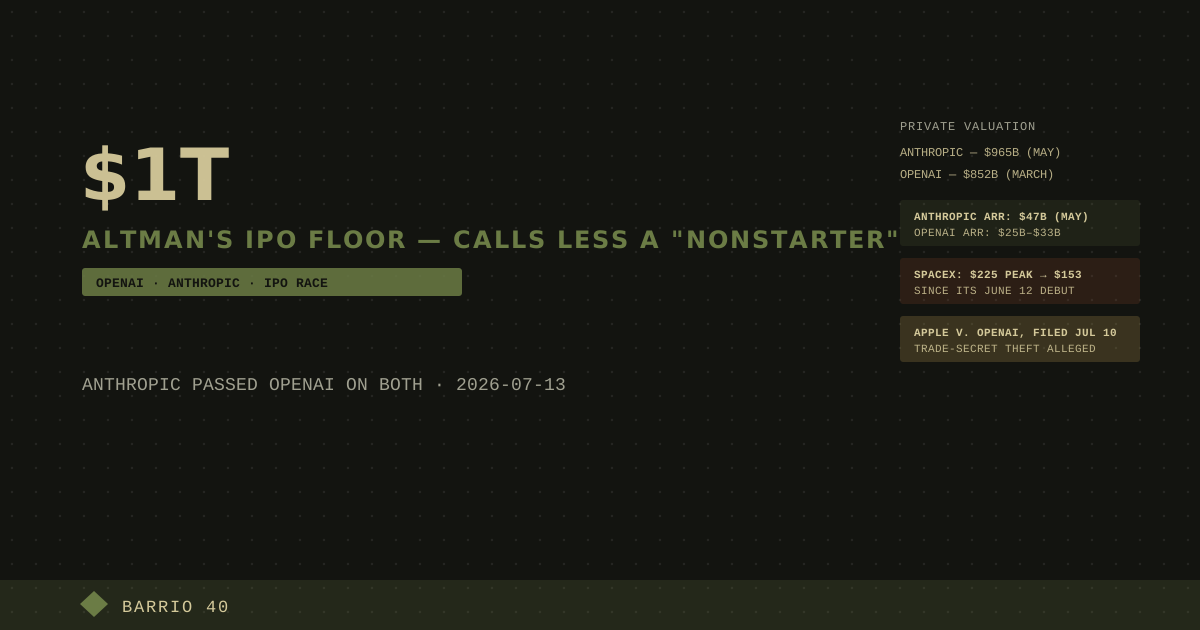
The valuation crossover happened first. OpenAI's most recent private round, closed in March, priced the company at $852 billion. Anthropic's Series H, which closed in May and pulled in $65 billion from investors including Samsung, SK Hynix, and Micron as strategic infrastructure partners rather than pure financial backers, priced Anthropic at $965 billion — the first time Anthropic's private valuation has exceeded OpenAI's. The revenue crossover followed within weeks and is the more striking of the two, because revenue is harder to talk a market into believing than a funding round's headline number. Anthropic's run-rate revenue has moved from roughly $87 million in January 2024 to $1 billion by December of that year, to $9 billion at the end of 2025, and then in a five-month acceleration to $14 billion in February, $19 billion in March, $30 billion in April, and $47 billion in May 2026. OpenAI's own annualized revenue reached $25 billion by the end of February — up 17% from $21.4 billion at the close of 2025 — with some more recent disclosures putting the run rate closer to $33 billion by May. Either figure leaves OpenAI behind Anthropic on revenue for the first time since the two companies began being compared on that basis at all.
TWO CONFIDENTIAL FILINGS, ONE SEASON
Confidential S-1 filings let a late-stage company begin SEC review privately, without disclosing revenue, margins, or risk factors until roughly fifteen days before a public roadshow. OpenAI filed first, in late May, working with Goldman Sachs and Morgan Stanley toward a target as early as September at a valuation reported anywhere from $730 billion to $852 billion depending on how conservatively the bankers are modeling a public market that has never priced a company quite like it. Anthropic filed on June 1, naming Goldman Sachs, JPMorgan, and Morgan Stanley as underwriters, targeting an October listing on the Nasdaq, and reportedly aiming to raise more than $60 billion in the offering itself — a number that, if it holds, would rank among the largest single primary raises in US IPO history regardless of what happens to either company's headline valuation. Two frontier labs, filing within a month of each other, both nominally aiming for public debuts inside a six-week window this autumn: it is the first time the industry's two largest players have been on a collision course toward the public markets at the same moment, and neither has priced a range or set a date it has confirmed publicly.
THE $1 TRILLION FLOOR
Altman's position, as described to his own advisers, is specific: any IPO valuation below $1 trillion is a "nonstarter." That is a real gap to close. OpenAI's last private mark was $852 billion; the low end of the range reportedly being modeled for the public offering is $730 billion, below even that private mark, reflecting the discount public markets often apply to companies whose reported 2025 revenue of roughly $20 billion arrived alongside projected 2026 losses near $14 billion and cumulative losses that could reach $115 billion by 2029, with profitability not expected until the following decade. Closing a $150-billion-plus gap between "what the bankers think the market will pay" and "what the CEO has told them he will accept" is not a rounding error to be solved with a strong roadshow; it is the kind of gap that either gets closed by waiting for better conditions, gets closed by a narrative shift dramatic enough to move institutional pricing models, or does not get closed and the IPO slips. Anthropic, notably, has not had to make the same argument to anyone — its last private round already cleared $965 billion, meaning a public listing at anything above that mark is a story about growth, not a story about persuading the market to accept a number the private markets haven't yet agreed to.
WHY SPACEX'S STOCK CHART IS SPOOKING OPENAI'S ADVISERS
SpaceX went public on June 12, the first of the AI-adjacent trio — SpaceX, OpenAI, Anthropic — to actually test the public market rather than talk about testing it. The debut itself was a headline success: more than $85 billion raised, a valuation that touched $2.77 trillion on the first trading day. What happened next is the part OpenAI's bankers keep referencing. The stock ran further to a $225 peak within the following week, then reversed, closing recently at $153 — a decline of roughly a third from that peak, and enough to cost Elon Musk his brief hold on trillionaire status. According to reporting cited by OpenAI's own advisers, that reversal is a specific data point in the argument for delaying OpenAI's own listing to 2027: a market that bid up the first mega-cap AI-infrastructure debut and then sold off a third of the gain within weeks is not obviously a market that will hold a $1 trillion line for a company still years from profitability. The choice being put to Altman, per that reporting, is a binary one — wait until 2027 for a shot at the $1 trillion figure he wants, or accept a lower number sooner. He has so far declined the second option.
THE LAWSUIT THAT LANDED MID-PREP
Five days before this piece, on July 10, Apple sued OpenAI in the Northern District of California, alleging that the company ran a coordinated campaign — "at every level, from members of its Technical Staff to its Chief Hardware Officer," per the complaint — to extract Apple trade secrets covering product designs, manufacturing processes, and supply-chain strategy, in service of OpenAI's own consumer hardware ambitions. The complaint names Tang Tan, OpenAI's hardware chief and a 24-year Apple veteran who led iPhone and Apple Watch product design before departing, and alleges he directed departing Apple employees to bring "actual parts" from Apple products to OpenAI job interviews for "show and tell" sessions. A second defendant, eight-year Apple systems electrical engineer Chang Liu, is accused of keeping an Apple-issued laptop after joining OpenAI in 2026 and using it to download confidential technical documents. The complaint puts a number on the broader pattern: more than 400 former Apple employees now work at OpenAI. OpenAI's response was a flat denial — "We have no interest in other companies' trade secrets. We remain focused on building innovative technology that empowers people everywhere" — but a denial does not make the case disappear from the disclosure documents a roadshow audience will read. A pending federal lawsuit alleging a coordinated, executive-level scheme to steal a trading partner's trade secrets is precisely the kind of risk factor that gets its own numbered section in an S-1, and precisely the kind of overhang institutional investors price at a discount until it resolves — one more reason, on top of a $150 billion valuation gap and a spooked post-SpaceX market, that OpenAI's bankers may prefer 2027 to September.
WHAT'S ACTUALLY DRIVING ANTHROPIC'S NUMBERS
The revenue crossover is not an accounting trick; it reflects a genuinely different business. Anthropic's growth is overwhelmingly enterprise — API and Claude Code usage billed to businesses that keep paying regardless of which consumer chatbot is trending that week — while OpenAI's revenue mix leans more heavily on consumer ChatGPT subscriptions, a category more exposed to the kind of price competition this site has covered repeatedly this year, from SpaceXAI's Grok 4.5 undercutting Claude Opus 4.8 by up to 80% on coding-task cost to DeepSeek routing a larger share of OpenRouter's enterprise token volume than any single US lab. Anthropic's own monetization has required active tending, not a straight line: the Fable 5 credit-only cutover this site covered on July 7 has since been extended twice, most recently through July 19, as the company kept adjusting the promotional window in response to user pushback rather than forcing paying subscribers onto $10-per-million-input, $50-per-million-output pricing on the original schedule. That willingness to keep re-negotiating the terms of its own flagship pricing, even as the topline revenue number climbs past $47 billion, is a detail a prospectus will have to explain somewhere between the growth chart and the risk factors.
TWO BETS, TWO TIMELINES
Strip away the specifics and the two companies are running different experiments in the same market. Anthropic is betting that a public listing timed off the back of a private round that already cleared $965 billion is a story the market will simply confirm — enterprise revenue that has quintupled since February, a valuation set five weeks before filing, and an October target that gives it a full quarter's head start on whatever SpaceX's stock does next. OpenAI is betting that a $1 trillion figure Altman has decided is non-negotiable will hold even though it sits above the company's last private mark, above the range its own bankers are modeling, and now above a market that just watched the closest comparable debut lose a third of its value inside a month — while carrying a federal trade-secret lawsuit into whatever roadshow eventually happens. Neither bet has resolved. What has changed since June 1, when this site first noted OpenAI's Frontier Governance Framework was itself timed to land ahead of an IPO roadshow, is that the gap between the two companies' negotiating positions is now visible in three separate numbers — valuation, revenue, and the discount a market applies to a defendant in active federal litigation — rather than in one.
WHAT THIS MEANS FOR TEAMS BUILDING ON EITHER PLATFORM
None of this changes what Claude or GPT can do today, but it is directly relevant to any team weighing platform risk over a multi-year commitment. A company racing toward a public listing under pressure to hit a CEO-mandated valuation floor has a structural incentive to prioritize the metrics that number depends on — consumer growth, headline pricing, announcement cadence — over the kind of quiet reliability enterprise buyers actually want, and OpenAI's repeated pricing and access changes this year are consistent with that incentive regardless of what's driving them internally. Anthropic's position looks more stable by the numbers, but "stable" is relative for a company whose own flagship pricing has moved three times in six weeks and whose revenue trajectory this quarter would be difficult for any organization to sustain without some friction showing up somewhere. The practical takeaway is the same one this site has offered before, now with sharper numbers behind it: treat both labs' current roadmaps and pricing as provisional until each company's public filings — whenever they actually land — show what the business really looks like once it has to report quarterly rather than negotiate a promotional extension whenever users push back.