THE SPEC SHEET: WHAT LONGCAT-2.0 ACTUALLY IS
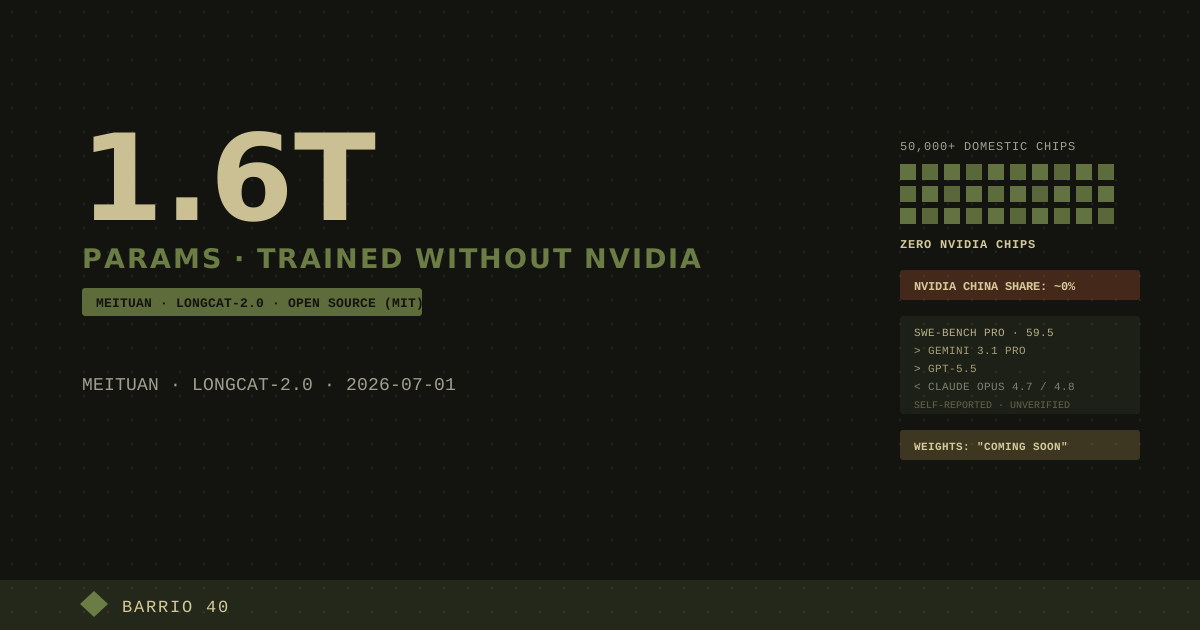
Strip away the chip story for a moment and LongCat-2.0 is, on its own terms, a serious release. It is a mixture-of-experts model — 1.6 trillion parameters in total, with a dynamic subset in the 33-to-56-billion range, averaging around 48 billion, actually active for any given token — which is the architectural trick that lets a model this large run at a cost closer to a much smaller dense model. The one-million-token native context window and the model's explicit tuning toward autonomous coding, software engineering, AI agents, and repository-scale tasks put it squarely in competition with the agentic-coding tier that OpenAI's Codex integration and Anthropic's Claude Code have spent the past year establishing as the most commercially contested category in the industry. Meituan's own account of the pretraining run — more than 35 trillion tokens, no rollbacks, no irrecoverable loss spikes — is the kind of operational detail labs disclose specifically to signal that a training run of this scale isn't a one-off fluke; it's evidence the infrastructure behind it is stable enough to repeat.
The license is the part product teams will care about first. MIT is about as permissive as an open release gets — no share-alike requirement, no obligation to open-source anything built on top of it, no restriction on commercial deployment — which puts LongCat-2.0 in the same commercially-friendly category as Llama's more permissive releases rather than the copyleft-adjacent terms some open-weight labs still attach. The catch is that there is, at the moment, nothing to deploy. Both the GitHub repository and the Hugging Face model card carry the same placeholder: weights coming soon. What Meituan open-sourced on June 30 is the architecture, the training methodology, and the benchmark claims. The actual downloadable model — the thing a team could point infrastructure at — has not shipped. That is a meaningful gap between "open-sourced" as a headline and "open-sourced" as a fact on the ground, and it is worth tracking separately from everything else in this story.
FIFTY THOUSAND CHIPS THAT AREN'T NVIDIA'S
The chip story is the actual news here, and it is more specific than the general "China is building its own AI hardware" narrative this site and every other outlet covering the sector has been tracking for over a year. LongCat-2.0 is being described by outlets covering the release as the first model of this parameter scale to complete both training and inference entirely on a domestic Chinese compute cluster — more than 50,000 ASIC accelerators, with evidence in Meituan's technical materials pointing toward Huawei's Ascend line, coordinated through Huawei's HCCL collective-communication software rather than Nvidia's NCCL. That is a distinction with weight: inference on domestic chips has been demonstrated before, and mid-sized models trained on non-Nvidia hardware have been demonstrated before, but a trillion-parameter-class model trained start to finish on a 50,000-chip domestic cluster, with no Nvidia hardware anywhere in the run, is a different and harder claim — one that speaks directly to whether China's chip industry can now support frontier-scale pretraining, not just frontier-scale serving.
The context that makes this land is Nvidia's own account of its position in China. Speaking publicly in recent weeks, CEO Jensen Huang said the company has "largely conceded" China's advanced AI chip market to Huawei, putting Nvidia's current market share of AI accelerators sold into China at effectively zero and describing the outcome bluntly: "conceding an entire market the size of China probably does not make a lot of strategic sense, so I think that has already largely backfired." Analyst forecasts from Digitimes put China's AI GPU self-sufficiency at roughly 80% by 2030. LongCat-2.0 is what that trajectory looks like in a single data point rather than a projection: the export-control logic that has shaped US AI policy for three years rests on the assumption that denying Nvidia's newest silicon caps what Chinese labs can train. A 1.6-trillion-parameter model trained on 50,000 domestic chips with a stable, rollback-free run is direct evidence that the cap, if it ever held, is no longer holding at the scale that matters.
WHERE IT ACTUALLY LANDS ON THE BENCHMARKS
The specific numbers are worth sitting with, and worth treating with the same caution this site applies to every self-reported benchmark from every lab, regardless of country of origin. On SWE-bench Pro, LongCat-2.0 scored 59.5, ahead of both Gemini 3.1 Pro and GPT-5.5 on the same test. On SWE-bench Multilingual, it scored 77.3, again ahead of that pair. On both benchmarks, it trails Anthropic's Claude Opus 4.7 and 4.8, which remain the reference point at the top of the agentic-coding category. Meituan's broader claim — that LongCat-2.0's overall capability is roughly comparable to Gemini 3.1 Pro — is Meituan's own framing, generated on Meituan's own evaluation harness, and has not yet been reproduced on an independent third-party leaderboard. That is not a reason to dismiss the numbers; it is a reason to hold them provisionally until outside researchers with no stake in the release run their own evaluations, which is the same standard this site applied to Zhipu's GLM-5.2 IDOR-detection claims two weeks ago and to OpenAI's own SWE-bench figures for GPT-5.6 before that.
The OpenRouter usage data is a different kind of signal, and arguably a more immediate one. Within hours of the release, LongCat-2.0 was reportedly the most-used model on the platform — a number that reflects developer curiosity, price sensitivity, and the novelty of a credible frontier-adjacent open release more than it reflects production trust, but it is also the fastest, least gameable read on how the developer community actually responds to a release like this. Zhipu's GLM-5.2 built a similar early usage spike on a narrower claim, security-benchmark parity with Mythos 5 on one detection task. LongCat-2.0's claim is broader — general coding and agentic capability approaching a frontier closed model — and it arrived with a chip story attached that GLM-5.2 didn't have. Whether usage converts into anything durable depends entirely on what happens when the weights actually post and independent evaluators get their hands on the model.
WHY THIS LANDS DIFFERENTLY THAN GLM-5.2 DID
This site has now covered nineteen days of the export-control fight that started on June 12, when the US government ordered Anthropic to pull Claude Fable 5 and Mythos 5 from general availability, through Mythos 5's narrow restoration to roughly 100 vetted critical-infrastructure organizations on June 26, through Commerce Secretary Howard Lutnick's direct call to OpenAI's Sam Altman about staggering GPT-5.6's release behind a similar approval gate, through Zhipu's GLM-5.2 claiming rough parity with Mythos 5 on IDOR vulnerability detection two weeks ago. Each of those stories complicated the export-control rationale from a slightly different angle, but all of them were still, fundamentally, arguments about which models can do what. LongCat-2.0 is a different kind of complication. It is not a claim that a foreign lab matched a restricted model's capability with its own weights — it is a claim that a foreign company matched frontier-scale training itself, on hardware the controls were specifically designed to keep out of reach, with a stable run at trillion-parameter scale. If GLM-5.2 raised the question of whether restricting one company's model access actually denies the underlying capability to determined foreign labs, LongCat-2.0 raises the more structural question of whether restricting chip exports denies China the ability to build frontier-scale training infrastructure at all. Jensen Huang's own answer to that question, delivered before LongCat-2.0 existed, was that the policy has "already largely backfired."
None of this means the original national-security concerns behind Fable 5 and Mythos 5's restriction were unfounded, or that Washington's broader chip strategy has failed on every axis it was built to address — export controls can meaningfully slow a buildout even when they don't stop it entirely, and a single stable training run, however impressive, is not the same thing as a mature, at-scale domestic AI hardware industry. But the trade-off Washington is running — restrict access, accept the diplomatic and commercial cost, in exchange for a meaningful capability gap — gets harder to defend with each data point suggesting the gap is closing faster on the hardware side than the policy assumed, and LongCat-2.0, chip cluster and all, is the clearest such data point yet.
WHAT TO DO WITH THIS IF YOU'RE EVALUATING OPEN MODELS
The immediate, practical answer for most teams is: not much, yet. There is no LongCat-2.0 to download today. The benchmark numbers are Meituan's own, run on Meituan's own harness, and worth treating as a claim rather than a conclusion until independent evaluators reproduce them. The right move is to watch two dates rather than act on one announcement: the day the weights actually post to Hugging Face, and the first independent benchmark run that either confirms or complicates Meituan's numbers. Teams already running open-weight models in production — on GLM, on Qwen, on Llama variants — should add LongCat-2.0 to the watchlist for a genuine MIT-licensed, commercially unrestricted, agentic-coding-tuned alternative once the weights land, but there is nothing to migrate toward this week.
The more durable takeaway sits above any single model. This is now the second time in a month that a lab operating outside US export-control jurisdiction has produced a credible frontier-adjacent claim, and the first time one of them has attached a hardware story to it — evidence that the once-wide gap between closed frontier labs in the US and open alternatives out of China keeps narrowing regardless of the policy apparatus built to widen it. For teams weighing multi-vendor resilience, the operational lesson isn't to bet the roadmap on China's domestic chip trajectory or on any single unverified benchmark claim. It's to keep tracking open-weight releases as a genuine second column next to closed frontier APIs, rather than a hedge that only matters in the abstract — because the gap between "interesting research claim" and "thing your team can actually deploy" has been shrinking all year, and LongCat-2.0, once its weights actually ship, is a reasonable bet to shrink it again.