THE MEMO ARRIVED ON THE COMPANY'S BEST EARNINGS DAY IN YEARS
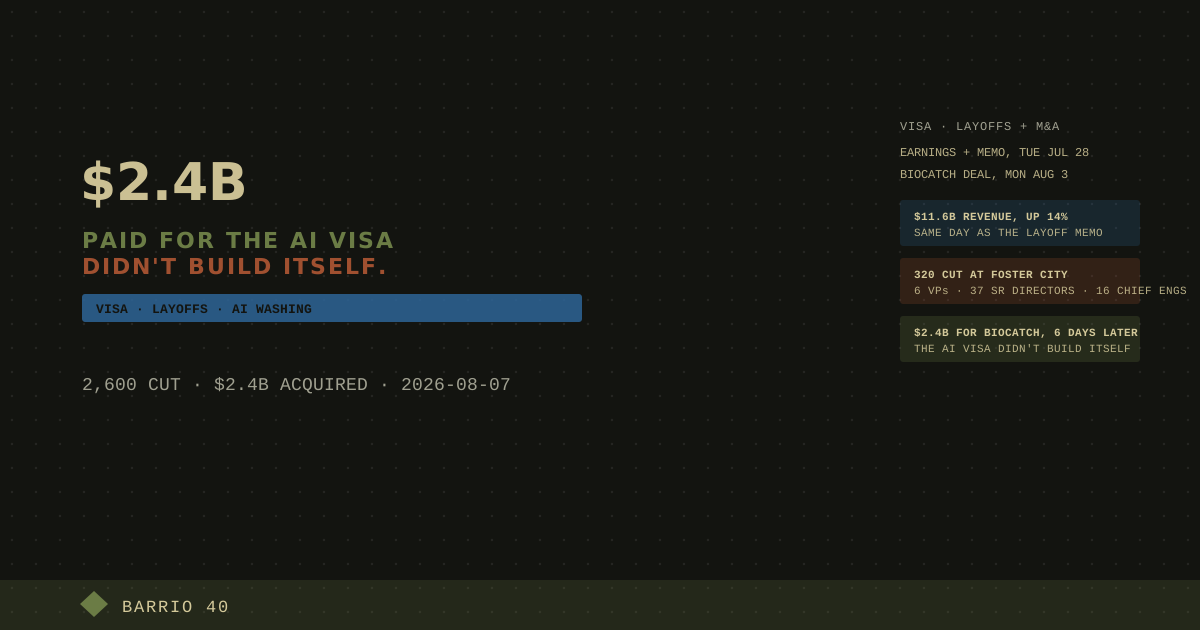
Visa's fiscal third quarter, reported July 28, was not a company under financial pressure by any conventional measure. Net revenue reached $11.6 billion, up 14 percent from a year earlier. GAAP net income hit $5.6 billion, up 7 percent, with earnings per share up 10 percent to $2.97; on a non-GAAP basis, net income was $6.3 billion. Processed transactions rose 10 percent to 71.7 billion, and quarterly payments volume crossed $4 trillion for the first time in the company's history. Visa returned $6.2 billion to shareholders that quarter alone — $4.9 billion in buybacks, $1.3 billion in dividends. That same morning, McInerney told employees the company was cutting about 2,600 jobs, roughly 7 percent of its global headcount, concentrated in technology and product groups, framing the move around AI-driven efficiency and a shift toward reinvesting in stablecoins, cross-border payments, and value-added services. The timing put a record quarter and a mass layoff notice in the same press cycle, with AI doing the explanatory work for why a company posting double-digit revenue growth needed to shed thousands of roles at once.
THE WARN NOTICE SHOWS WHO ACTUALLY LEFT
The global figure McInerney's memo cited is diffuse; the California WARN Act notice filed July 31 is specific. It lists 320 reductions, all at Visa's Foster City headquarters campus: six vice presidents, 37 senior directors, 16 chief engineers or architects, and dozens of senior software engineers and researchers beneath them. These are not entry-level roles cut for payroll savings — LinkedIn postings for comparable vice-president positions at Visa's Foster City office list salaries between $235,700 and $458,000, before sales incentives. A cut framed around "AI doing more of the same work" landed hardest on the people most likely to be the ones actually capable of building that AI internally: the senior architects, engineering directors, and technical VPs who would normally own that build. The Foster City reductions are a slice of the roughly 2,600 cut worldwide, but they're the slice that maps most directly onto the claim in McInerney's memo — and the one hardest to square with a company that, in the same week, chose to buy its way into the AI capability rather than build it with the staff still on hand.
SIX DAYS LATER: $2.4 BILLION FOR THE AI VISA DIDN'T BUILD
On August 3, Visa announced an all-cash, $2.4 billion agreement to acquire BioCatch, a behavioral-biometrics company founded in 2011 that profiles how users actually move, type, and navigate to flag account takeover and AI-driven scams — the kind of fraud-detection system a card network with Visa's transaction volume would otherwise need serious in-house engineering to build. BioCatch is Israeli in origin, with R&D still based in Tel Aviv and a corporate headquarters in New York; private equity firm Permira bought a controlling stake in the company roughly two years earlier at a valuation of about $1.3 billion. Visa's $2.4 billion price tag is nearly double that, in two years, for a company it is now buying outright rather than partnering with or building a competitor to. BioCatch's own announcement said it would keep operating with its existing team once the deal closes — meaning the engineers who actually built this specific piece of fraud-fighting AI keep their jobs. They just don't work for Visa's technology organization; they work for the company Visa paid a premium to acquire instead of hiring, retaining, or upskilling the staff it laid off six days earlier.
"AI EFFICIENCY" IS CARRYING MORE NARRATIVE THAN EVIDENCE
Nothing about the BioCatch deal proves the layoffs were bogus — companies build and buy AI capability simultaneously all the time, and fraud-detection behavioral biometrics is a genuinely hard, specialized field that an acquisition can shortcut faster than an internal team could replicate from scratch. But the sequence undercuts the specific story McInerney's memo told: that Visa was cutting headcount because AI was now doing work humans used to do. If that were the operative logic, the $2.4 billion six days later would have gone toward tooling and retraining the technical staff who remained, not toward buying an outside company's finished product and its intact engineering team. What actually happened is a more familiar pattern — a profitable company reducing its most expensive technical headcount and reaching for "AI" as the explanation, while its capital allocation shows the AI capability itself is still being purchased on the open market, not manufactured by the workforce that was told to make way for it. AI-cited layoffs and AI-company acquisitions increasingly arrive as a pair across the industry this year; Visa's version is unusually easy to trace because the earnings call, the WARN filing, and the acquisition announcement all landed inside the same eight days, with dollar figures attached to each.
WHAT THIS MEANS FOR TEAMS BUILDING ON AI
When a company cites "AI efficiency" for a layoff, the WARN filing — not the memo — tells you what actually happened, because it lists titles, seniority, and location instead of a rounded percentage. Read it alongside the company's next few weeks of M&A activity: if the business turns around and pays a premium to acquire the exact capability it just claimed AI would let existing staff cover, that's a strong signal the "AI" in the layoff announcement was doing narrative work, not causal work. For anyone building AI products aimed at enterprise buyers, the more reliable read of demand isn't a competitor's layoff messaging — it's who they're acquiring and at what multiple. BioCatch went from a $1.3 billion private-equity valuation to a $2.4 billion strategic acquisition in two years without shrinking; that's the number that describes what fraud-detection AI is actually worth to a payments network right now, and it's a far more honest data point than any memo about doing more with less.