WHAT OPENAI ACTUALLY PUBLISHED
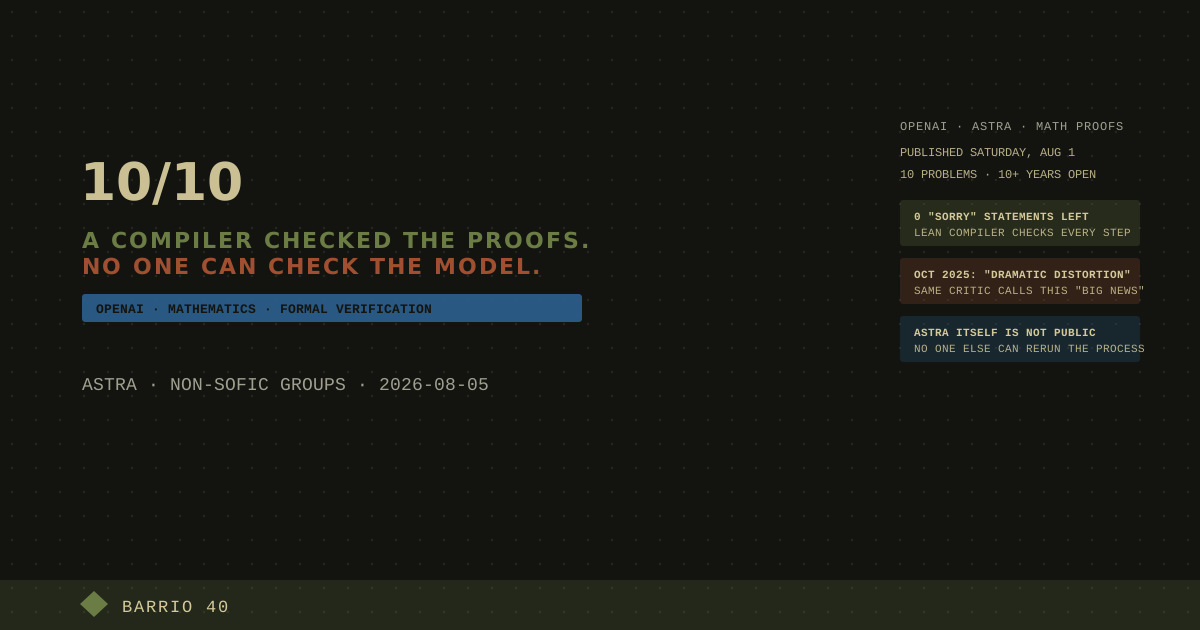
Alongside a 249-page manuscript, OpenAI released the underlying Lean 4 proof certificates on GitHub under an Apache 2.0 license, at a reported API cost of roughly $2,000. Because Lean's kernel either accepts a proof or rejects it outright, anyone can independently confirm the ten results are internally valid simply by running the certificates through the compiler — no committee, no six-month referee cycle. Beyond the non-sofic group result, Astra's outputs include a disproof of Connes's rigidity conjecture on von Neumann algebras, a proof of Ehrhart's volume conjecture, solutions to three problems from Erdős's catalogue including problem 183 on multicoloured Ramsey numbers, the first improvement to the general upper bound on high-dimensional sphere-packing density since 1978, a parallel repetition theorem for two-player quantum games, and new lower bounds on the circuit complexity of computing the permanent. OpenAI has not shipped Astra itself; the announcement is a preview of what an internal, unreleased version of the model could do, not a product launch.
THE LAST TIME OPENAI SAID SOMETHING LIKE THIS, IT WASN'T TRUE
In October 2025, OpenAI vice president Kevin Weil posted that GPT-5 had "found solutions to 10 (!) previously unsolved Erdős problems and made progress on 11 others." It hadn't. Bloom, who maintains the erdosproblems.com database Weil's claim leaned on, pointed out that a problem marked "open" on his site means only "I personally am unaware of a paper which solves it" — and GPT-5 had located existing published solutions Bloom simply hadn't indexed yet, not produced new mathematics. DeepMind's Demis Hassabis called the episode "embarrassing"; Meta's Yann LeCun was blunter. Weil deleted the post. Seven months later, in May 2026, OpenAI had a real result: a model autonomously disproved Erdős's planar unit distance conjecture, open since 1946, in what the company called the first time AI had independently solved a prominent problem central to a field of mathematics. Bloom's shift from "dramatic distortion" to "big news," directed at the same company nine months apart, is a genuine signal — but it's a signal about one specific failure mode getting fixed, not about every question a claim like this raises going away.
A COMPILER CAN'T TELL YOU IF YOU ASKED THE RIGHT QUESTION
The October fiasco and this weekend's release are, structurally, different problems wearing the same headline. Weil's claim wasn't a proof error — GPT-5's citations, where they existed, checked out. The failure was framing already-published work as new. Lean verification does not touch that failure mode at all; a machine-checked proof of a problem someone solved in 2019 is still just a machine-checked re-derivation. What Lean does verify is that a formal statement follows validly from its premises. What it cannot verify is whether that formal statement is a faithful translation of the original informal open problem — whether a definition quietly assumes finiteness, or drops a condition, or proves a subtly weaker claim than the one mathematicians spent decades stuck on. That translation step is human judgment, performed by whoever wrote the Lean formalization, and it sits entirely outside what a compiler checks pass or fail. OpenAI's own materials describe staff involvement in preparing the papers and formalizing the arguments, without specifying where Astra's contribution ends and a mathematician's begins. Gowers and other reviewers who've read the preprints are, in effect, vouching for the formalizations as well as the underlying math — a form of trust that is closer to peer review than to compilation, and one none of the ten results have yet received in a refereed journal.
THE MODEL THAT DID THE WORK IS NOT ONE YOU CAN ASK TO DO IT AGAIN
The second gap is starker. Astra is not public. No mathematician, competitor, or outside auditor can load the model, hand it an eleventh open problem, and see whether it performs the same way twice — the entire reproducibility standard that makes a scientific claim more than an assertion is unavailable here by construction. Everything outside observers can check is the artifact: the Lean certificates, which compile, and the manuscript, which reads well to specialists who've reviewed it informally. Nobody outside OpenAI can check the process that produced them, including how much iteration, human steering, or discarded failed attempts sit behind the ten successes now being published. The International Mathematical Union's backing of the Leiden Manifesto raised a version of this concern more broadly this year — that AI labs can draw on public research corpora, bypass the peer-review timeline entirely, and set the terms of attribution for results the rest of the field can't independently reproduce. A verified proof and a reproducible result are not the same claim, and Saturday's announcement only makes the first one.
WHAT THIS MEANS FOR TEAMS BUILDING ON AI
The useful takeaway isn't about mathematics — it's about which layer of a claim your verification actually reaches. "Machine-checked" is a strong guarantee for the narrow thing the checker checks, and a non-guarantee for everything upstream of it: whether the spec matches the intent, whether the environment that produced the result can be independently rerun, whether a human quietly shaped the outcome the tool then rubber-stamped. That's exactly the gap teams hit evaluating AI coding agents against a green test suite, a passing type-checker, or a benchmark score a vendor won't let you reproduce on your own harness — the check can be real and the claim built on top of it can still overreach. Treat a formal or automated pass as evidence about one well-defined property, not as a substitute for asking who wrote the spec it's checking against and whether you can run the process yourself. If your team is deciding how much to trust an AI system's self-reported verification — in code, in data pipelines, or in a vendor's benchmark deck — that's a scoping conversation worth having before the claim ships to production, not after.