JULY 10: THE HARDWARE CHIEF, THE ENGINEER, AND THE $6.5 BILLION DEAL BEHIND THE SUIT
Apple's complaint, covered on this blog August 25 under the headline that trade-secret theft ran "at every level, from its technical staff to its chief hardware officer," centers on two people: Tang Yew Tan, who spent roughly 24 years leading hardware engineering at Apple before leaving for OpenAI, and Chang Liu, a former Apple engineer. Both joined OpenAI's hardware group after OpenAI acquired io Products — the device startup founded by former Apple design chief Jony Ive — for $6.5 billion in 2025. Apple's theory is straightforward: as OpenAI raced to build its first consumer hardware device, it recruited scores of people who carried Apple's confidential engineering, manufacturing, and supply-chain knowledge with them, and used that knowledge to jump-start a program Apple says should have taken years longer to reach the same point. OpenAI's public rebuttal, posted August 3 with private emails and chat logs attached, said the opposite: "Apple's request for a preliminary injunction is both based on false information and completely unnecessary because we do not have, nor want, any of their trade secrets." Its evidence pointed the other direction — at Apple's own offboarding, including a manager who Apple allegedly left with access to a departed engineer's personal iCloud account for months after he quit.
AUGUST 6: OPENAI'S MOTION TO DISMISS — NAME THE SECRET, OR THERE'S NO CASE
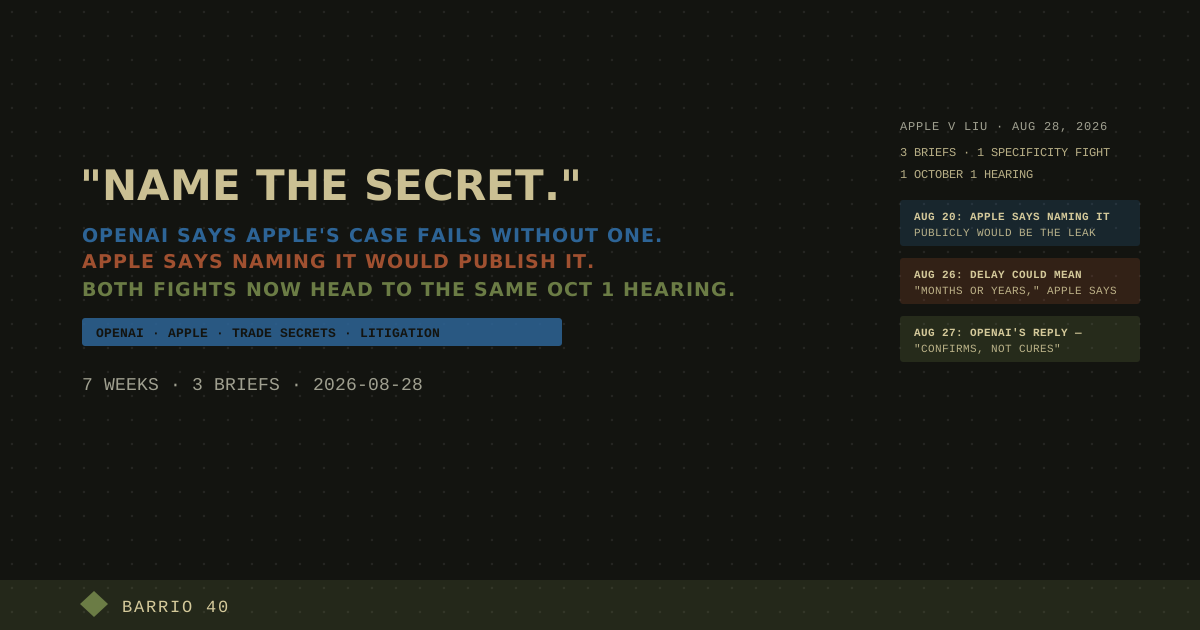
OpenAI's formal motion to dismiss, filed under Federal Rule of Civil Procedure 12(b)(6), doesn't argue that Tan and Liu never talked to their new employer about their old jobs. It argues something narrower and, if it works, more fatal to the whole case: that Apple's complaint never identifies an actual trade secret with enough specificity for a court, or a defendant, to know what's being litigated. Where the complaint describes Apple's hardware, manufacturing, and supply-chain knowledge, OpenAI's motion calls those descriptions categories, not secrets — the kind of general subject headings that could describe almost anything Apple's hardware group has ever worked on, rather than a defined piece of information a defendant could be shown to have taken. Apple's response to a request for a preliminary injunction was due to the court August 17, on a parallel track to the dismissal fight.
AUGUST 20: APPLE'S ANSWER — SPECIFICITY WOULD BE THE LEAK
Apple's 32-page opposition, filed August 19–20, argues OpenAI's motion "depends on distortion, speculation, and improper extrinsic evidence" — that the disputes OpenAI is raising are factual questions for discovery and trial, not grounds to throw the case out before either side has produced a document. Citing the Ninth Circuit's 2025 Quintara decision, Apple argues it doesn't have to lay out the precise contours of its trade secrets at the pleading stage, because doing so is itself a "fact dispute" properly resolved later, at summary judgment or trial — not now, in a complaint OpenAI's own lawyers, and the public, can read. The subtext is close to the surface: if Apple described its hardware and manufacturing secrets with the itemized precision OpenAI's motion demands, in a filing that becomes part of the public record the moment it's docketed, it would be publishing the very confidential information the lawsuit exists to protect. On the specific claims about Tan, Apple's brief argues the reasonable inference — that he solicited and obtained Apple's confidential hardware information before he'd finished leaving — belongs to Apple at this stage, not to OpenAI's competing read of the same emails.
AUGUST 26: THE CLOCK APPLE SAYS IS RUNNING AGAINST IT
A day before OpenAI's reply brief landed, Apple filed a separate complaint with the court — not about the trade secrets themselves, but about timing. OpenAI has agreed in principle to let Apple depose key witnesses, Apple's filing says, but has proposed that those depositions "occur only once, presumably at the end of fact discovery" — a sequencing that, Apple argues, could leave it waiting "months or years" before it can question the people it says took its designs. Apple's stated reason the schedule matters: "OpenAI could continue to use Apple's hardware trade secrets while racing to design and launch its own hardware device" for as long as the case's procedural clock allows. It's the same argument, aimed at a different lever — where the August 20 brief resisted specificity because publishing it would be the harm, the August 26 filing argues that delay itself is the harm, running in real time against a competitor that, Apple says, has every incentive to ship before the case catches up to it.
AUGUST 27: OPENAI'S REPLY — "CONFIRMS, RATHER THAN CURES"
OpenAI's reply brief, filed the next day, doesn't retreat from the specificity argument — it sharpens it into a structure. To state a claim under the Defend Trade Secrets Act, OpenAI's filing says, Apple has to connect three things about the same information and the same defendant: what the particular trade secret actually is, why that information qualifies for legal protection, and how a specific defendant improperly acquired, disclosed, or used it. "Neither Apple's Complaint nor its opposition ever completes that chain," the reply argues — Apple's opposition, rather than fixing the gap OpenAI's motion identified, "confirms, rather than cures, the Complaint's central defect." OpenAI goes further, characterizing Apple's trade secrets as "vague categories and catch-alls" and arguing Apple "cannot substitute attorney characterization for missing facts." On the inference question Apple raised about Tan, OpenAI concedes the general rule while drawing a hard line around it: "Rule 12 permits reasonable inferences from alleged facts," the reply says, but it "does not permit speculation to substitute for the missing act of misappropriation" — meaning, in OpenAI's account, Apple wants the court to assume the theft happened rather than plead facts showing that it did.
WHAT OCTOBER 1 ACTUALLY PUTS IN FRONT OF JUDGE DEMARCHI
The hearing now carries two separable questions that don't have to come out the same way. The first is whether the case survives at all: if Judge DeMarchi agrees with OpenAI that Apple's complaint never identifies a protectable secret tied to a specific act by a specific defendant, the federal trade-secret claims could be dismissed — though typically with a chance for Apple to amend, not necessarily the end of the litigation. The second, procedurally independent of the first, is whether Apple gets the preliminary injunction and expedited discovery it's asked for regardless of how the dismissal fight goes — relief aimed less at the merits than at freezing OpenAI's use of the disputed information and accelerating the deposition schedule Apple says is currently too slow to matter. A win for OpenAI on dismissal doesn't automatically answer the injunction question, and a loss on dismissal doesn't automatically hand Apple the injunction either — DeMarchi could grant one, both, or neither. What both sides agree on is that nothing about the specificity fight gets resolved by press release: three briefs and seven weeks in, the exact contents of Apple's alleged trade secrets still exist only inside sealed exhibits and the two companies' competing characterizations of them.
WHAT THIS MEANS FOR TEAMS BUILDING ON AI
Most companies never litigate a trade-secret claim, but the bind this case exposes shows up long before a lawsuit does: you cannot protect what you haven't specifically identified, and identifying it specifically is exactly the act that makes it easier to lose. If your team's valuable knowledge — a manufacturing process, a model architecture, a supply-chain relationship — only exists as a general sense that "we know how to do this and competitors don't," you have Apple's problem without Apple's legal budget: nothing concrete enough to enforce and nothing sealed enough to enforce it safely. The fix predates any dispute — a maintained, dated inventory of what specifically counts as confidential, kept under an NDA and disclosed only under protective order if litigation ever requires it, so you're never forced to choose between a case dismissed for vagueness and a public filing that hands the secret to the world. The other lesson cuts the other way, toward anyone hiring from a competitor: document, in writing, what a new hire is and isn't bringing with them, before the first day of work rather than after a subpoena — because in a dispute like this one, that documentation is the difference between "we hired someone with relevant experience" and a deposition transcript OpenAI would rather not read out loud in a courtroom.