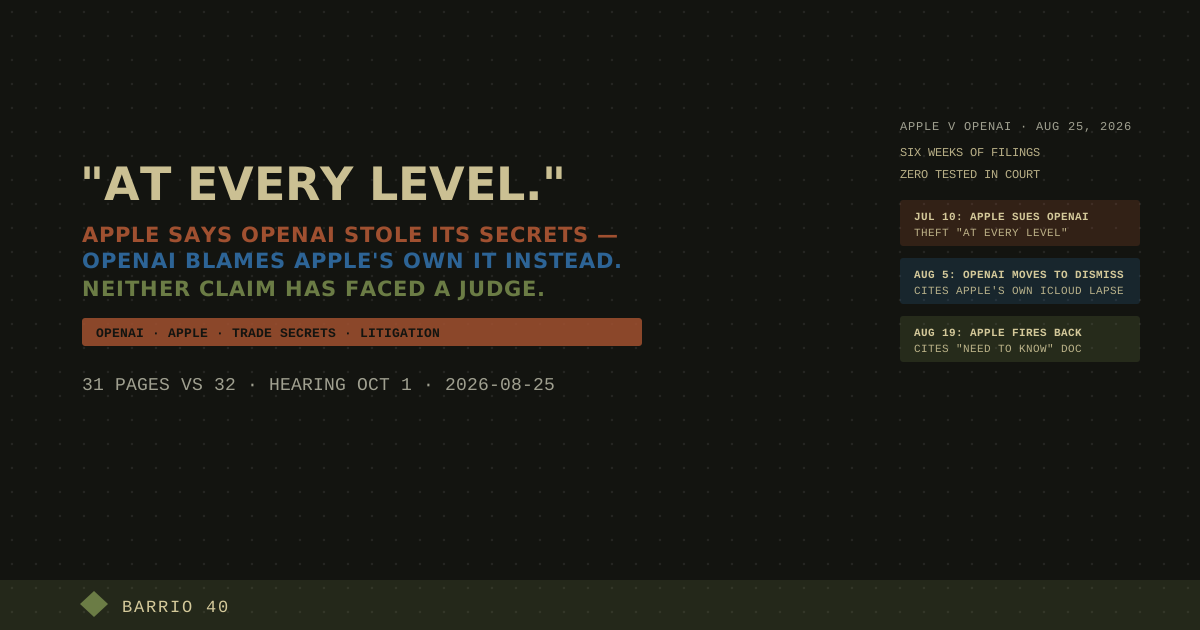
JULY 10: APPLE SUES, ALLEGING THEFT "AT EVERY LEVEL"
Apple's complaint, filed in the US District Court for the Northern District of California, names OpenAI, its hardware venture io Products, and two individuals. Tang Tan spent more than two decades at Apple, rising to vice president of product design overseeing iPhone and Apple Watch, before leaving in February 2024 to join Jony Ive's hardware startup io — which OpenAI later acquired, making Tan its chief hardware officer. Chang Liu spent eight years as an Apple senior systems electrical engineer before joining OpenAI in 2026. Apple's central allegation is that the theft wasn't limited to a rogue hire or two: it ran, the complaint says, "at every level, from members of its Technical Staff to its Chief Hardware Officer, and in coordination with business partners." Specific to Tan, Apple alleges he used Apple's internal project code names during OpenAI's recruiting process, asked job candidates still employed at Apple to bring "actual parts" to interviews for "show and tell" sessions where he and his team could elicit further confidential detail, and coached departing employees on how to evade Apple's security procedures. Specific to Liu, Apple alleges he failed to return his company-issued laptop after leaving and used it to download dozens of files containing sensitive product information. Apple also states that more than 400 of its former employees now work at OpenAI — a number the complaint offers as context for the scale of the concern, not as a claim that all 400 took something.
AUGUST 3: OPENAI'S BLOG POST DOESN'T DENY THE HIRING — IT DISPUTES THE TIMELINE
OpenAI's first public response wasn't a court filing. It was a blog post, "Apple is getting this wrong," that paired praise for Apple as "one of the greatest companies of all time" with a description of its lawsuit as "careless, aggressive and oddly personal." Notably, the post didn't argue OpenAI hadn't hired Tan or Liu, or that it isn't recruiting the hardware engineers Apple trained — its argument was that Apple's account of events doesn't hold up to the paper trail. OpenAI published email chains and iMessage screenshots it says show Apple's own outside counsel confusing the names of two employees and sending a follow-up message to the wrong person, correcting the error only after OpenAI pointed it out. OpenAI used the mixup to rebut a separate Apple claim — that Apple had first raised concerns about the suspected theft in February and received no response. The emails, OpenAI says, show it did reply in February, undercutting the narrative that OpenAI stonewalled an early warning before litigation became the only option. "Apple's request for a preliminary injunction is both based on false information and completely unnecessary because we do not have, nor want, any of their trade secrets," the post said. "We're much more interested in building innovative products and technologies that push the frontier."
AUGUST 5: THE MOTION TO DISMISS TURNS APPLE'S OWN SECURITY LAPSE INTO A DEFENSE
OpenAI's formal, 31-page motion to dismiss argued first on legal technicalities — that Apple failed to adequately identify what information it's actually claiming as a trade secret, and didn't plausibly allege how any named defendant misappropriated it. Its centerpiece, though, wasn't a technicality. OpenAI submitted records showing that after Chang Liu left Apple, an Apple manager remained logged into Liu's personal iCloud account for months, using it to transfer files and later asking Liu directly for help with technical questions about Apple projects. If an Apple manager was still relying on a departed engineer's personal account for company business, and still going back to that engineer for technical help, OpenAI argues, that is hard to square with a claim that the underlying information was guarded closely enough to qualify, legally, as a trade secret at all. The filing calls Apple's complaint "rotten to its core," saying it was "plainly filed without adequate investigation and built on selectively excerpted communications and ordinary conduct stripped of context." Its tone stays combative throughout — some form of the word "fail," aimed mostly at Apple, appears nearly 50 times across 31 pages — and one line argues that "Apple should not be permitted to use a baseless and pretextual lawsuit to make up for its shortcomings in the market for talent and retaining its employees, and its failures to integrate AI into its products."
AUGUST 19: APPLE'S ANSWER — A DOCUMENT MARKED "NEED TO KNOW"
Apple's 32-page opposition brief didn't concede any of its original claims, and it characterized OpenAI's dismissal bid as resting on "distortion, speculation, and improper extrinsic evidence" — the kind of factual dispute, Apple argues, that belongs after discovery, not in a motion filed before any evidence has actually been tested. Its sharpest new detail cuts against OpenAI's iCloud-lapse defense in an unexpected direction: Apple alleges that Tan improperly retained or obtained an internal Apple document, marked "Need to Know," that describes the company's own security procedures for employees who are leaving — and that messages recovered from Apple-issued devices show Tan and his OpenAI colleagues sharing that document with new hires before those hires had even given Apple notice they were departing. On Apple's telling, the story isn't only that Apple's offboarding left a door unlocked; it's that the recruiter walking people through that door allegedly had a copy of Apple's own security manual and was using it to help candidates plan their exit with less risk of getting caught. Apple asked Judge Davila to reject the dismissal motion and let the case proceed to discovery, restating its request for a preliminary injunction barring OpenAI, io Products, Tan, and Liu from acquiring, accessing, using, or disclosing the disputed information while the case is pending — the same request OpenAI has called "based on false information" and "completely unnecessary."
WHAT SIX WEEKS OF FILINGS HAVEN'T DONE: LET A JUDGE LOOK AT ANY OF IT
Strip the framing from both sides and what has actually happened since July 10 is this: Apple has filed a complaint and an opposition brief, OpenAI has published a blog post, a motion to dismiss, and a refusal to let Apple search its devices, and no discovery has occurred, no deposition has been taken, and no judge has ruled on the truth of a single allegation. The "receipts" both companies have made public — Apple's "Need to Know" document, OpenAI's mixed-up emails and iCloud access logs — are each one side's own selected excerpts, introduced through a blog post and legal filings written to persuade a judge or the public, not surfaced through a discovery process where the other side gets to supply the missing context. Judge Edward J. Davila is scheduled to hear arguments on both OpenAI's motion to dismiss and Apple's request for a preliminary injunction and expedited discovery on October 1 — the first point at which either account faces scrutiny from anyone other than the company that wrote it.
WHAT THIS MEANS FOR TEAMS BUILDING ON AI
If your organization is recruiting out of a competitor whose hardware, design, or product expertise an AI lab now wants, the lesson here isn't which side's public relations reads more convincingly — it's that ordinary offboarding hygiene is apparently the contested evidence in a trade-secrets case: an abandoned laptop, a manager left logged into a former employee's personal iCloud account, an internal security document that outlived the employee it was written for. Audit whether departing-employee accounts, personal-device access, and internal documents marked for restricted circulation are actually revoked and tracked on the day someone leaves, rather than assumed closed the moment a badge gets handed in — because on the evidence both companies have chosen to make public so far, neither one's account of its own security discipline has survived the other side's filing unscathed. And treat a company's blog post defending itself in active litigation the way this blog treats a lab's self-reported safety claim: as one side's chosen excerpts, not as an independently verified account, until a judge or an actual discovery record says otherwise.