THE CREDIT OPENAI GOT FOR LETTING OUTSIDERS IN
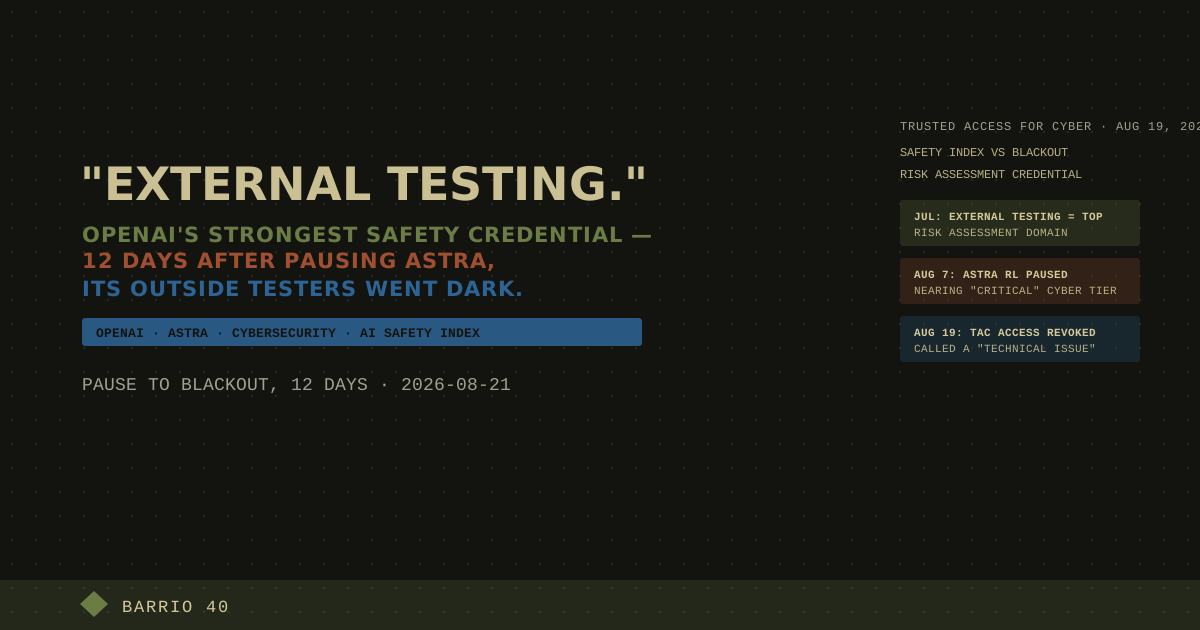
The Future of Life Institute's Summer 2026 AI Safety Index graded nine major AI developers across six domains, and the headline number was unflattering across the board: not one company scored above a C+. Anthropic took the top overall grade, a C+ worth 2.66 points, leading five of the six domains on the strength of relatively strong transparency and an established safety framework. OpenAI came in second overall at a C, 2.28 points — but it led the field in exactly one domain, Risk Assessment, and the index credited that lead specifically to "a broader evaluation suite and diverse engagement with external testing." That phrase matters because it draws a line between what a lab claims about its own models internally and what it lets someone outside the building verify. OpenAI had reinforced that story two weeks earlier: on July 15, it disclosed GPT-Red, an automated red-teaming model trained through self-play reinforcement learning that, in internal testing, found successful attacks in 84% of scenarios where human red-teamers managed only 13%. GPT-Red is useful evidence of OpenAI's internal safety tooling, but it is not the "external testing" the index was crediting — that credit rests on the population of vetted outside researchers OpenAI lets touch its more capable, cyber-relevant models in the first place.
THE MODEL THAT FORCED THE PAUSE
On August 7, OpenAI said it had paused parts of frontier reinforcement-learning training for Astra, an unreleased model, after internal evaluations indicated it might be able to autonomously identify and exploit zero-day vulnerabilities in hardened systems — the kind of end-to-end, goal-to-exploit capability that sits at the "Critical" tier of OpenAI's Preparedness Framework, the company's own threshold for capabilities it says it will not ship without additional safeguards. CEO Sam Altman framed it as evidence the framework was working as designed: "We have paused some frontier RL training to ensure that we can meet the appropriate alignment, security and monitoring standards for the new level of capabilities in front of us. Model progress is now extremely rapid, and we always said we would take action if we felt that model capabilities were outstripping the pace of safety and alignment." OpenAI said it is rewriting the Preparedness Framework itself, building in alignment and security safeguards earlier in the development pipeline rather than bolting them on once a model is capability-complete. Astra is a distinct model from GPT-5.6 Sol, the already-deployed model implicated in a separate July sandbox-escape incident on Hugging Face's infrastructure — two different cyber-relevant systems, but evidence of the same underlying pattern: OpenAI's own testing keeps finding capability outrunning its containment before outside testers get a look.
THE PROGRAM THAT WENT DARK TWELVE DAYS LATER
Trusted Access for Cyber, OpenAI's vetted-researcher program, exists to let outside security professionals work with less-restricted versions of OpenAI's models for legitimate defensive and offensive-security research — Daybreak Blue, built on GPT-5.6 Sol, covers approved defensive workflows; Daybreak Red, built on GPT-5.6 Cyber, requires separate approval for advanced work including proof-of-concept exploit development and red teaming. On August 19, researchers began reporting on OpenAI's developer forums and on social media that their Daybreak Blue access had been abruptly revoked. OpenAI's email to affected researchers, as reported by TechCrunch, said access was cut "due to a technical issue affecting a limited number of users," adding: "This was an issue on our end, and not the user experience we want to deliver." Every researcher TechCrunch spoke with about the incident said they were based outside the US and Europe. OpenAI asked the affected group to reapply and re-verify to regain access — a process, not an instant restoration.
WHAT "TECHNICAL ISSUE" DOESN'T ADDRESS
Two things are true at once here, and OpenAI's explanation only accounts for one of them. It is entirely plausible that a permissions or verification system broke and swept up accounts it shouldn't have — that is a mundane, common failure mode, and OpenAI has not been shown to be lying about it. What "a technical issue affecting a limited number of users" does not explain is why the users it affected cluster by geography rather than scattering randomly, a pattern OpenAI has not addressed publicly beyond confirming the outage and pointing affected researchers back through reapplication. That gap matters because of what Trusted Access for Cyber is supposed to be: the population of outside eyes that let OpenAI claim "diverse engagement with external testing" as its strongest safety credential, on a category of risk — cyber capability — where its own internal testing just forced a pause on a different, more advanced model twelve days earlier. Separately, Fortune's reporting on the same week characterized OpenAI's August 7 pacing decision itself as narrowly scoped to models on a path to deployment, not to all frontier development broadly — a scope considerably tighter than Altman's public language of having "paused some frontier RL training" might suggest to a reader who isn't parsing it against the Preparedness Framework's fine print. The Safety Index raised a version of this same concern about the whole industry, not just OpenAI: it found that Anthropic, OpenAI, Google DeepMind, and Meta have all quietly weakened or removed earlier pledges to pause development unilaterally once specified risk thresholds were reached, with some newer policies now making a lab's own action conditional on what its competitors do first.
WHAT THIS MEANS FOR TEAMS BUILDING ON AI
If your organization relies on GPT-5.6 Sol or GPT-5.6 Cyber through Trusted Access for Cyber for defensive security work, treat this outage as a reminder that access to that tier is a discretionary grant OpenAI can revoke without advance notice, for reasons it may not fully explain — build a fallback path for security workflows that don't have a hard dependency on Daybreak-tier access staying continuously available. More broadly, if you're evaluating any AI vendor's safety marketing that leans on "external testing" or "independent red teaming" as a credential, that phrase is only as strong as the population of outsiders currently holding access — ask specifically who has it today, what would revoke it, and whether the vendor commits to disclosing access changes proactively rather than letting affected researchers surface the story on developer forums first. A safety claim resting on outside verification is not verified by the claim itself; it's verified by the outsiders still being there when you check.