THE 30 DAYS ANTHROPIC SAID IT NEEDED
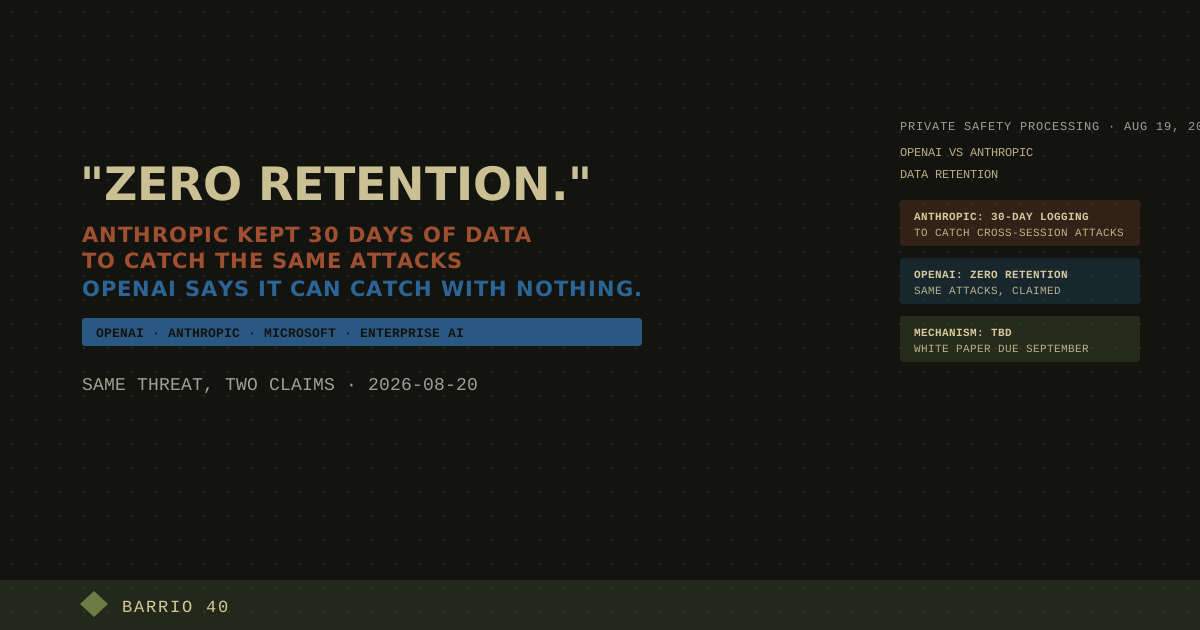
When Anthropic launched Claude Fable 5 and Claude Mythos 5 on June 9, it attached a condition that overrode existing zero-retention deals for anyone using them: prompts and outputs on every Mythos-class model would be retained for 30 days, on every surface where the model is offered, first-party or third-party. Content its trust-and-safety classifiers flagged as violating usage policy could be kept for up to two years; an opt-in toggle extended retention to five years for training. Anthropic's own framing was specific about why 30 days of plain logging, rather than nothing, was the price of admission: the company said it needed the data to defend against attacks that "operate across many requests" — the sort of multi-step misuse where any single message looks unremarkable and only the sequence gives it away — and to cut down false positives while doing it. The reaction from at least one large customer was immediate. Microsoft limited employee use of Fable 5 while its legal team evaluated what the new retention terms meant for its own data-handling obligations, according to reporting on the internal pushback.
THE SAME PROBLEM, A DIFFERENT ANSWER
Ten weeks later, OpenAI described the identical threat model and offered the opposite fix. Previewing Private Safety Processing to early customers on August 19, OpenAI's head of product policy, Aleah Houze, put the underlying problem in almost the same terms Anthropic had used to justify retention: "risks are emerging not just by looking at one single prompt and response pair, but when you look over time at multiple interactions." The example OpenAI has offered publicly is a two-session pattern — someone asks about a vulnerability in a piece of software in one conversation, then asks about tools for remote system access in a later, separate one. Neither question is alarming by itself; only the pair, read together, is. That is precisely the "attacks that operate across many requests" category Anthropic cited to justify 30-day logging. OpenAI's claim is that Private Safety Processing catches it without logging anything: the system is described as examining signals and metadata around a customer's interactions rather than the interactions themselves, and when it flags a risk, it sends OpenAI a narrowly defined signal describing the type and severity of the activity — not the prompts or responses that triggered it. Zero Data Retention, OpenAI says, stays intact underneath it.
WHAT "COMPATIBLE WITH ZERO RETENTION" IS BEING ASKED TO COVER
The claim under scrutiny is narrower than "OpenAI doesn't look at your data" — it's that a system can recognize a pattern spanning two or more separate sessions from the same customer without keeping anything that lets it connect session two back to session one. Detecting that a later question builds on an earlier one requires some form of state that persists between them and is tied to the same account; OpenAI has not yet said publicly what that state consists of, only that it isn't the raw prompts and completions. Outside observers have floated ephemeral processing, homomorphic encryption, or an on-device safety model as candidates, but that is speculation, not confirmation — OpenAI itself has deferred the technical explanation to the white paper it says will accompany a broader rollout in September. Until that document exists, "compatible with Zero Data Retention" is a claim being marketed several weeks before the mechanism that would let anyone outside OpenAI verify it becomes public. It's also worth noting the promise was never absolute to begin with: OpenAI's existing Zero Data Retention terms already reserve the right to retain content and have a human review it when automated classifiers detect a likely policy violation, "if reasonably necessary" to investigate or prevent severe risk — an exception that predates Private Safety Processing and sits alongside it.
WHO GETS THE PREVIEW, AND WHO DOESN'T
Private Safety Processing is not available to ChatGPT's Free, Plus, Go, or Pro subscribers; it applies to eligible enterprise and API customers under Zero Data Retention agreements. Microsoft and Databricks are named as the early testers — Microsoft being the same company reported to have pulled back on Fable 5 over Anthropic's retention terms just weeks earlier, which makes it a natural first customer to reach for an alternative that promises the same protection without the logging. That timing is also what makes the framing hard to miss: multiple outlets covering the announcement described it explicitly as OpenAI positioning itself against Anthropic's policy, not as an unrelated internal safety upgrade. Whether that positioning survives contact with the technical paper is a separate question from whether it's effective marketing today.
WHAT THIS MEANS FOR TEAMS BUILDING ON AI
If your organization is running Fable 5 or Mythos-class Claude models under Anthropic's mandatory 30-day retention and is waiting to see whether OpenAI's alternative lets you route sensitive workloads back to zero-retention infrastructure, September's white paper is the document to actually read before you move anything — not the press coverage of the preview. A vendor claiming it can detect cross-session attack patterns without retaining session-linkable state is making a specific technical claim, and "we can't tell you how yet" is a normal thing to say about a system still in early testing, but it is not yet a claim you can audit. In the meantime, treat "Zero Data Retention" from either provider as a claim with an asterisk you need to read the fine print on: Anthropic's already carries a two-year exception for flagged content and a five-year opt-in for training; OpenAI's already carried a human-review carve-out for classifier-flagged violations before this announcement, and now carries a second system whose actual data-handling footprint hasn't been documented. Ask your vendor, in writing, exactly what persists across sessions to make cross-request detection possible at all — because something has to, and knowing what that something is matters more than which company says "zero" more confidently.