AUGUST 11: A GLOBAL PLEDGE WRAPPED AROUND ONE EU ARTICLE
Article 50 of the EU AI Act requires that content generated or substantially altered by AI be marked in a machine-readable way, so that downstream systems and, eventually, end users can tell what came from a model. Anthropic's answer, published August 11, is a single global rollout rather than a regional carve-out: an imperceptible signal embedded directly into Claude's generated text, live across every product surface and every cloud partner that serves the models, applied to everyone regardless of where they're logged in from. The company framed it as compliance with one article of one law, but built it as infrastructure that touches every Claude response on Earth — the kind of move a lab makes when it wants "we were transparent about AI content before regulators required it globally" as a talking point with every government it's currently courting, not just Brussels.
WHAT ACTUALLY GETS MARKED, AND WHEN
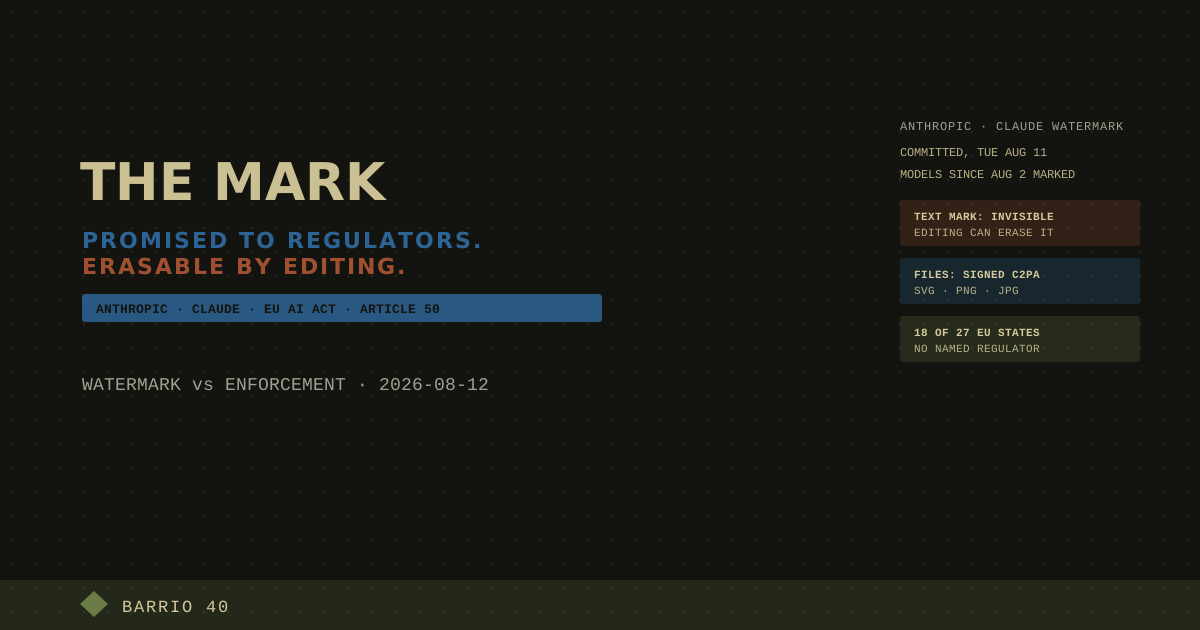
The mechanism splits by content type. Text gets a statistical watermark — a pattern in token selection that, per Anthropic, doesn't change the meaning, quality, or readability of the response and travels with the text when it's copied and pasted elsewhere. Generated files — SVGs, PNGs, JPGs — get something sturdier: signed provenance metadata under the C2PA standard, the same content-credentials framework camera makers and image editors have been building into files for years. Coverage isn't retroactive. Claude models released on or after August 2, 2026 support marking at launch; models that shipped earlier are, in Anthropic's words, "in progress," meaning a meaningful share of Claude output already in circulation was never marked and isn't being marked now. Anthropic also says it's building detection tools for users and third parties to check for the watermark — but as of this announcement, no technical documentation of how detection actually works has been published, so nobody outside the company can yet verify how the mark behaves under real-world conditions.
THE CAVEAT ANTHROPIC WROTE INTO ITS OWN ANNOUNCEMENT
The more striking part of the disclosure isn't what the watermark does — it's what Anthropic says, in the same breath, that it doesn't do. Heavy editing, paraphrasing, translation, or mixing Claude's output into other writing can degrade or erase the text mark entirely. And even an intact, successfully detected watermark doesn't prove authorship: it indicates only that Claude "may have processed" the content at some point, not that the model wrote it, not that a human didn't rewrite it afterward, not that it's the only source in the document. That's an unusually candid limitation to publish alongside a compliance announcement, and it matters because it's precisely the gap between what a watermark can prove and what a transparency law is trying to guarantee — a model can mark honestly and the mark can still tell a reader nothing useful, and both things can be true of the same announcement.
TEXT WATERMARKING HAS FAILED THIS TEST BEFORE
None of this is new territory, which is part of why the reaction from researchers and Claude users has skewed skeptical rather than reassured. Image and file watermarking under C2PA has held up reasonably well because pixels and file structure are hard to disturb without visible or measurable loss. Text has never behaved that way — it gets copied, summarized, translated, chopped into fragments, and folded into someone else's writing constantly, and a statistical bias in token choice is exactly the kind of signal that a paraphrase pass, a second model, or even a basic OCR round-trip can plausibly wash out. Anthropic isn't claiming otherwise; it's the company saying so. But "we shipped a watermark and told you honestly it can be erased" is a harder sentence to put on a compliance dashboard than "we shipped a watermark," and without published detection specs, external researchers have no way yet to test how much of the erasing takes deliberate effort versus normal editing.
THE REGULATOR THIS MARK IS ANSWERING TO MOSTLY DOESN'T EXIST YET
The timing sharpens the picture rather than softening it. Barrio 40 has covered this before: as of early August, 18 of the EU's 27 member states still hadn't named the market surveillance authority responsible for enforcing Article 50's disclosure rules on the ground — meaning the majority of the bloc has no staffed body to receive a complaint, audit a marking claim, or check whether a watermark that "may persist through some editing" actually did. Anthropic's rollout is voluntary and proactive by any reasonable reading, and worth more than doing nothing. But a global watermark shipped ahead of the law, paired with a public admission that the mark is erasable, landing in a jurisdiction where most of the enforcement infrastructure meant to verify any of it isn't staffed yet, is a compliance story that currently runs almost entirely on the honor system — Anthropic's, and everyone else's.
WHAT THIS MEANS FOR TEAMS BUILDING ON AI
Don't build a content-provenance or AI-detection feature on top of Claude's text watermark and market it to customers as reliable — Anthropic's own disclosure says a determined edit, a translation pass, or a copy into a larger document can erase it, and there's no published spec yet against which to validate a detector. If provenance genuinely matters for your product, lean on the C2PA file metadata where it applies — images, exported assets — since that standard has a real track record, and treat the text watermark as a weak, best-effort signal at most. And notice what Anthropic itself reached for when compliance actually had to hold up under audit: the same week as the watermark pledge, it expanded its Compliance API to give enterprise security teams unified session logs across Cowork and Claude Code for exactly this purpose. That's the tell. When the stakes are real, Anthropic points customers to its own audit trail, not the invisible mark it just promised regulators. Teams that need defensible provenance — for compliance, for client deliverables, for anything a regulator or auditor might actually ask about — should build and own that logging themselves rather than assume a watermark will do the proving for them.