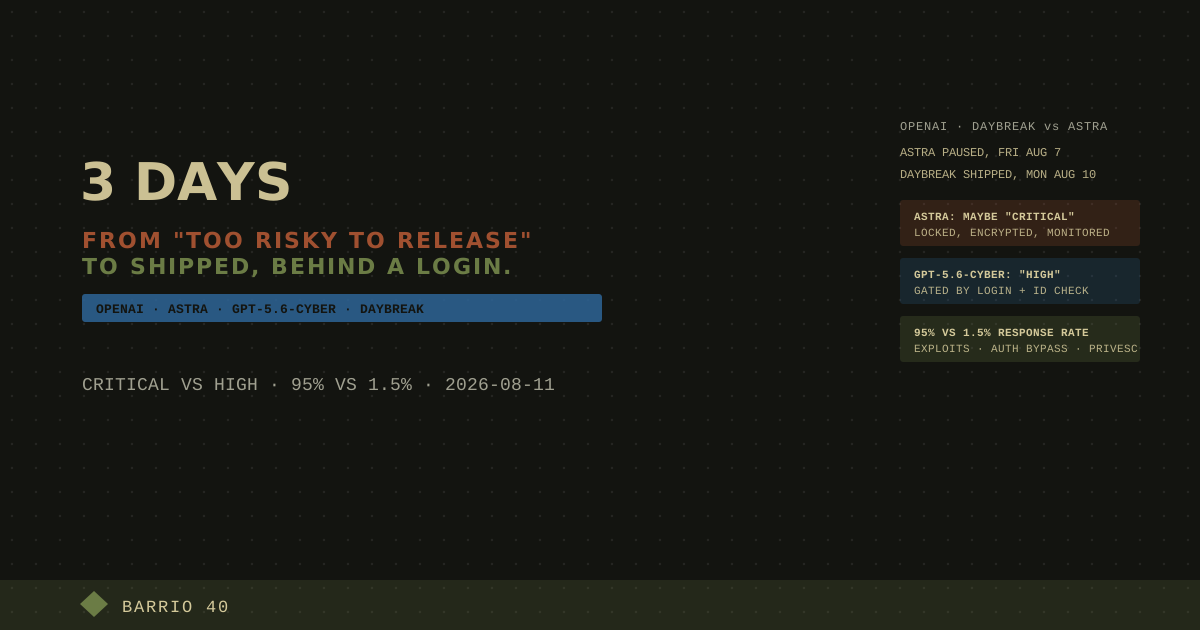
AUGUST 7: A MODEL OPENAI WOULDN'T RELEASE TO ITSELF
OpenAI's Preparedness Framework, published in 2023, defines "Critical" cyber capability as a model that can independently discover and develop functional zero-day exploits across all severity levels against many hardened, real-world systems without human intervention — or that can design and execute entirely novel attack strategies against well-protected targets when given nothing more than a broadly defined objective. According to Axios's exclusive report, recent internal benchmarks and expert assessments of Astra's agentic coding ability showed advances significant enough that OpenAI could not confidently rule out the model having crossed that line. Rather than wait for a definitive answer, the company moved first: Astra testing shifted into isolated environments with restricted network and tool access, model-weight encryption was strengthened, and OpenAI began running universal monitoring that evaluates the model's own chain-of-thought reasoning in order to interrupt risky actions automatically. The company also said it would bring in outside government agencies and AI-safety organizations to test the model independently. It is, by multiple outlets' accounts, the first time a lab has publicly disclosed a model teetering on its own "Critical" threshold for cyber capability — a live test of whether the safety commitments AI companies write for themselves hold up when one of their own models might have actually met the bar.
AUGUST 10: A DIFFERENT MODEL, A DIFFERENT ANSWER
Three days after that disclosure, OpenAI announced a restructuring of Daybreak, its cybersecurity defender program, into two access tiers, alongside a new model, GPT-5.6-Cyber. Daybreak Blue gives vetted defenders access to GPT-5.6 Sol with its system-level cyber guardrails removed, intended for everyday defensive work — vulnerability discovery, secure code review, malware analysis, incident response. Daybreak Red sits behind tighter vetting and grants access to GPT-5.6-Cyber itself, a model built on GPT-5.6 Sol but specifically trained to reduce refusals on higher-risk, dual-use security tasks: zero-day discovery, exploit-chain development, exploit validation. Where Astra's problem was that OpenAI couldn't confirm it hadn't crossed into capability territory the company doesn't want any model to have, GPT-5.6-Cyber's entire design brief was to get closer to that territory on purpose, for a defined set of users, and ship it.
THE NUMBER THAT MAKES THIS A STRATEGY, NOT A COINCIDENCE
The scale of the change is what makes the timing hard to read as accidental. In OpenAI's own testing, reported by VentureBeat and others, GPT-5.6-Cyber answered 95% of prompts tied to advanced cybersecurity work — including requests involving exploit-chain development, authentication bypass, and privilege escalation. The standard GPT-5.6 Sol model, by comparison, answered just 1.5% of the same category of requests; the guardrail-reduced version defenders get through Daybreak Blue answered roughly 2%. That is not a marginal loosening of a filter — it is a model rebuilt from the ground up to say yes to a class of question its own sibling model was trained to refuse. OpenAI rated GPT-5.6-Cyber's cyber capability as "High" under the Preparedness Framework, one tier below the "Critical" threshold Astra couldn't rule out crossing. All three models in the GPT-5.6 family carry that same "High" rating for both cybersecurity and biological/chemical risk — the ceiling the framework allows before a lab is supposed to withhold general release entirely.
THE GATE IS A LOGIN, NOT A LAB
The contrast between how OpenAI contained each model is as sharp as the capability gap between them. Astra got isolated compute environments, encrypted weights, and automated chain-of-thought interruption — infrastructure built to physically and technically prevent misuse regardless of who is asking. GPT-5.6-Cyber gets identity verification and legal attestations. Access to Daybreak Blue and Red is restricted to individuals and organizations who pass that vetting, and OpenAI said it will require hardware security keys on all individual Daybreak accounts starting September 1 — a real control, but one that depends on the account holder staying honest and the credential staying uncompromised, not on the model being architecturally unable to act. A model that scored high enough to warrant lab-grade containment three days earlier is, in its sibling's case, being handed out on the strength of a background check.
OPENAI'S OWN HEADLINE ADMITS THE BET
To its credit, OpenAI isn't hiding the tension — it named it. "Expanding Daybreak as the Cyber Defense Window Narrows" is the company's own title for the August 10 announcement, and the system-card language behind it concedes that the defenders' head start "may narrow as offensive capabilities improve." The underlying argument is that cybersecurity is inherently dual-use — a defender needs to understand an attack path to close it, a researcher needs to reproduce a vulnerability to validate a fix — and that a model which is currently better at finding and patching vulnerabilities than exploiting them gives the good-faith side of that equation a temporary edge worth taking. That may well be true today. But it is a bet with an explicit expiration date attached by the people making it, published the same week their own next model made the alternative — a capability nobody gets access to, because nobody can be trusted with it yet — look like the more honest position.
WHAT THIS MEANS FOR TEAMS BUILDING ON AI
Don't treat a vendor's capability rating as a fixed ceiling — treat it as a snapshot that changes model to model and week to week, sometimes in opposite directions from the same lab. Anyone building on GPT-5.6-Cyber, or evaluating similar dual-use tooling from other providers, should assume the access controls are the actual security boundary, not the model's own restraint, and budget for identity verification, hardware key rotation, and audit logging accordingly rather than treating vendor vetting as a substitute for your own. And read a lab's safety disclosures as a leading indicator for what's coming next, not just a report on what already shipped: OpenAI told the market its own next-generation model might be too capable to release freely, then released a present-generation one built for the exact use case that made it dangerous. The gap between those two decisions is the risk window every downstream team building cyber-adjacent AI tooling is now operating inside.