THE DISCOUNT CAME WITH A CATCH FROM THE START
When DeepSeek shipped V4 in mid-July, it didn't just cut prices — it restructured how a frontier model charges for tokens in the first place. V4 introduced peak-and-off-peak pricing tied to the Beijing clock: during weekday windows of 9:00 a.m. to noon and 2:00 p.m. to 6:00 p.m., per-token rates doubled. For the flagship V4 Pro, output pricing moved from roughly 6 yuan per million tokens off-peak to 12 yuan at peak; for the smaller V4 Flash, from about 2 yuan to 4 yuan. Time-of-day pricing is standard in electricity markets and cloud spot instances; it had never been applied to a frontier LLM API before. DeepSeek was explicit that this wasn't meant to read as a price increase — the company framed it as load management, promised customers 24 hours' notice before any rate change took effect, and left the headline "cheapest frontier-adjacent model" positioning fully intact for anyone willing to schedule around the clock.
AUGUST 1: THE DISCOUNT MET DEMAND IT COULDN'T ABSORB
V4 Flash's "0731" build entered public beta on July 31 with pricing held flat — DeepSeek's cache-miss input rate stayed at roughly $0.14 per million tokens, still a small fraction of what closed frontier labs charge. The demand that followed was not gradual. According to figures reported by the third-party inference platform OpenCode, DeepSeek V4 Flash processed 8 trillion tokens in a single day on August 1 — roughly 5 trillion on free-tier usage and 3 trillion on paid traffic routed through OpenCode alone. That is a volume spike landing on a model DeepSeek had pushed to general availability only days earlier, and it arrived before any pricing announcement — evidence that whatever came next was responding to capacity strain that already existed, not one DeepSeek was inventing to justify a change.
AUGUST 6: TWO ANNOUNCEMENTS, ONE DAY, OPPOSITE DIRECTIONS
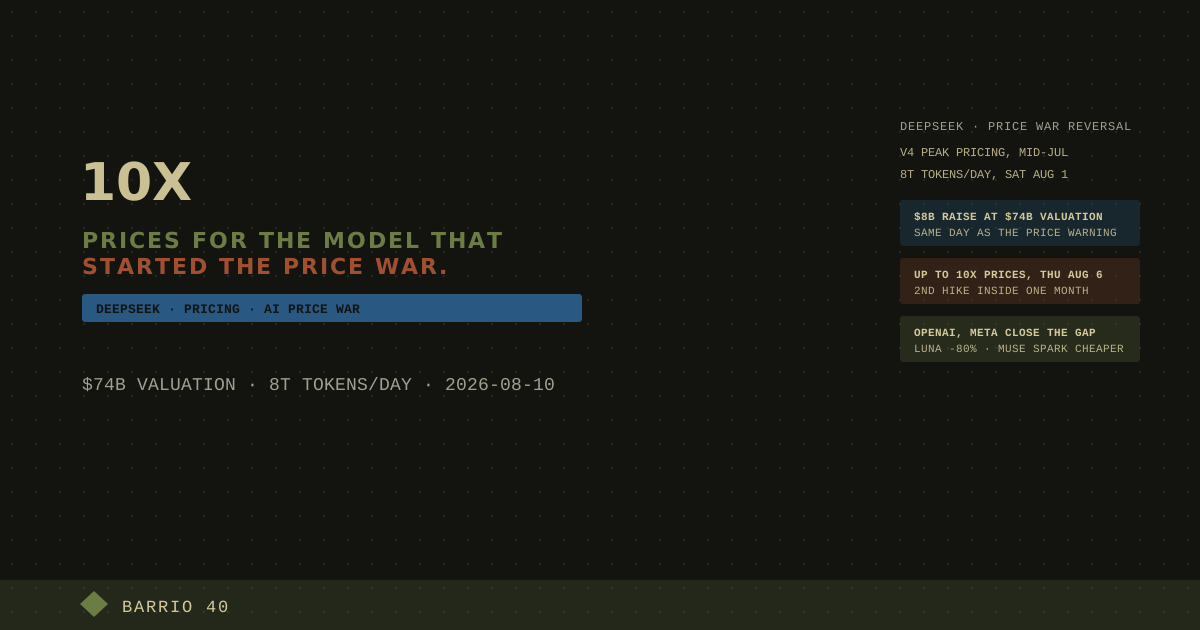
DeepSeek's second funding round had been paused for weeks after founder Liang Wenfeng's private remarks to investors leaked online. Bloomberg reported on Thursday, August 6, that the round had resumed, with DeepSeek seeking close to $8 billion at a pre-money valuation of roughly 500 billion yuan — about $74 billion, up from the $50 billion valuation on the $7.4 billion first round it closed in June. The syndicate reportedly includes China's national AI investment fund, NetEase, JD.com, IDG Capital, and others, with Monolith Management in talks to join; proceeds are earmarked for data center buildouts, and signing is expected to close by late August. Separately, on the same day, DeepSeek told developers it planned to broadly raise API pricing "in the near future" and that the increase would be significant — its second pricing move inside a month, arriving without a published rate card, an effective date, or the specific multiplier attached.
THE DEFENSE DOESN'T DENY THE MULTIPLE — IT NORMALIZES IT
DeepSeek researcher Junxiao Song, who co-developed the GRPO reinforcement-learning method used to train the company's model lineup, addressed the concern directly on X rather than leaving it to a spokesperson: he argued that even a 2x-to-10x increase would still leave DeepSeek undercutting most Western rivals. The arithmetic supports the claim without softening it — a 10x jump on V4 Flash's $0.14-per-million cache-miss input rate lands near $1.40, still below many closed frontier-model input rates from OpenAI, Anthropic, and Google. But confirming that a 10x figure is even on the table is itself the story; it turns "significant" from a vague warning into a specific range developers now have to budget against. An engineer at OpenCode offered a different explanation for the timing, arguing the move looks less like a company chasing margin and more like traffic management — a system that hit 8 trillion tokens in a day may need higher prices to throttle demand back to what its infrastructure can actually serve, independent of whether DeepSeek is losing money on any given token.
THE TIMING UNDERCUTS THE ONE ADVANTAGE DEEPSEEK HAD LEFT
Developer pushback online, including from AI builder Michael Guo, focused less on whether DeepSeek could still claim to be cheap and more on whether being cheap still mattered as much as it used to. OpenAI cut pricing on GPT-5.6 Luna by 80 percent just three weeks after launch. Meta's Muse Spark 1.2 already undercuts DeepSeek V4 Flash on list price. And the same week, Alibaba released Qwen3.8-Max — a 2.4-trillion-parameter model Alibaba is positioning as competitive with leading systems from OpenAI and Anthropic — with open weights for the flagship and a smaller 27-billion-parameter variant both due on Hugging Face and ModelScope in the week of August 10, making it the first Max-class Qwen model ever open-sourced. DeepSeek's advantage was never that it matched frontier labs on raw capability; it was that it was close enough while costing a fraction of the price. Every one of those rivals just moved toward DeepSeek's price, or past it, in the same stretch of weeks DeepSeek is moving away from it.
WHAT THIS MEANS FOR TEAMS BUILDING ON AI
Treat any vendor's per-token price as a variable to monitor, not a constant to hard-code into a cost model — DeepSeek moved its own pricing twice in under a month, in both directions, from the same product line. If the traffic-management read is right, the same time-of-day throttling logic can reappear at any provider that ships a genuinely cheap model and gets more demand than it planned for; build cost visibility and multi-provider fallback into inference pipelines now rather than after a rate change lands with 24 hours' notice. And watch the capital events, not just the pricing pages: a fundraising round and an IPO on the calendar are leading indicators for a vendor's pricing behavior, and they tend to land closer to the pricing announcement than the public narrative admits. DeepSeek's is landing on the same day.